Monday, July 30, 2012

The Federal Reserve, Gold, Crude Oil and the Dollar’s Demise

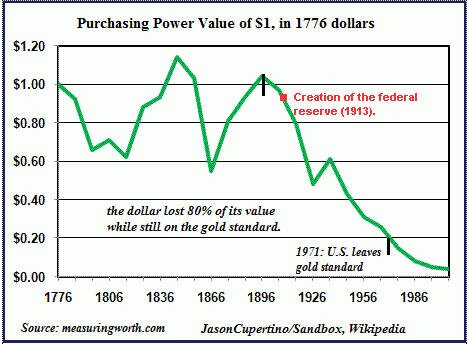
The Federal Reserve through its various monetary mechanisms has a major impact on the value of the U.S. Dollar and over time has destroyed the purchasing power of the fiat base currency used in the United States.
Interestingly enough, the following quote comes directly from the Federal Reserve’s website regarding one of its primary mandates, “In setting monetary policy, the Committee seeks to mitigate deviations of inflation from its longer-run goal and deviations of employment from the Committee’s assessment of its maximum level.”
The chart below illustrates the horrific job the Federal Reserve has done of protecting the purchasing power of the U.S. Dollar since its creation.
Dollar Creation By The Federal Reserve
In light of the longer-term malaise seen above, the Dollar Index futures have recently rallied sharply higher as Europe continues to flail in a slow and agonizing decline which will ultimately lead to a complete fiscal disaster.
Sovereign debt concerns continue to mount regardless of what the European technocrats spew publicly and the U.S. Dollar has been the primary beneficiary of these seemingly growing concerns.
This brings me to the purpose of this article. Most of the articles I write are focused on option based trades, but I decided it was time to put forth a more comprehensive scenario that could unfold over the next few years as a result of excessive monetary stimulus through various quantitative easing mechanisms developed by the Federal Reserve Bank.  “A mild change” to say the least . . .
As discussed above, the U.S. Dollar Index futures have moved higher throughout most of 2012. Any significant increase in the U.S. Dollar is a growing concern among central bankers as it correlates toward deflation. Deflation is the Fed’s biggest enemy, besides themselves of course.
Next week the Federal Reserve will release statements relating to the economic condition of the United States. Furthermore, the Fed also will discuss if it will initiate another dose of monetary crack for a capital market place that is addicted to cheap money and zero interest rates. At this point, the so-called marketplace is the antithesis of free by all standard measures.
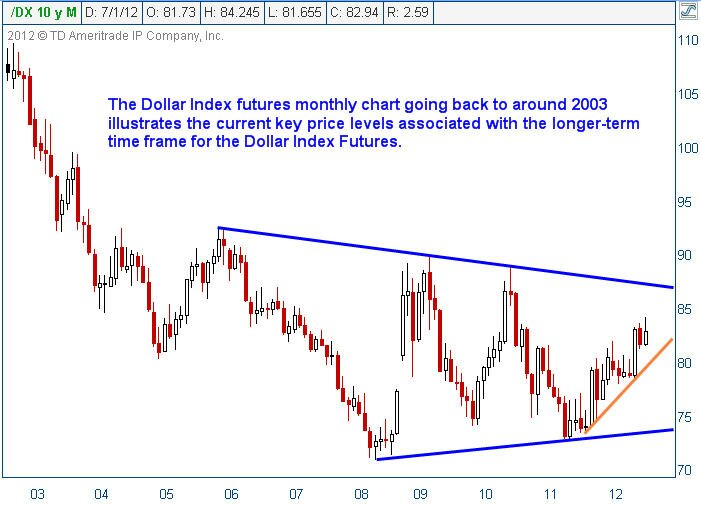
Consider the long-term monthly chart of the U.S. Dollar Index futures illustrated below:
Dollar Index Value Chart
The U.S. Dollar Index futures are in an uptrend that dates back to mid 2011. The orange line illustrates the uptrend and represents a key price level for the U.S. Dollar Index. For those unfamiliar with basic technical analysis, the rising orange trendline will act as buying support until the Dollar eventually breaks down through it signaling the bullish move higher has ended.
This brings us to a rather interesting potential observation. Today Mario Draghi, Chairman of the European Central Bank (ECB), made public comments regarding the readiness of the ECB to act if need be to safeguard the European Union. The Dollar Index Futures plummeted on the statement and remained under selling pressure most of the trading session on Thursday.
If a mere comment from the ECB can have such a damaging impact on the valuation of the Dollar, what would happen to the Dollar if the Fed initiated a new easing mechanism?
The answer is simple, the U.S. Dollar would immediately be under selling pressure. Selling pressure in the U.S. Dollar Index generally leads to a rally in risk assets such as equities and oil futures. Over the longer-term, a weak Dollar is also positive for precious metals and other hard assets.
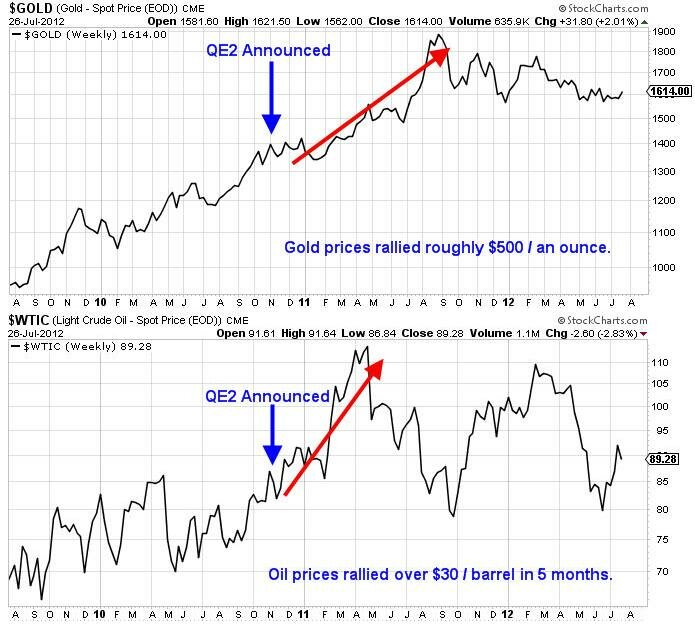
As an example to illustrate the power of Quantitative Easing as it relates to the price of both gold and oil, consider the following chart:
Spot Gold Price Chart
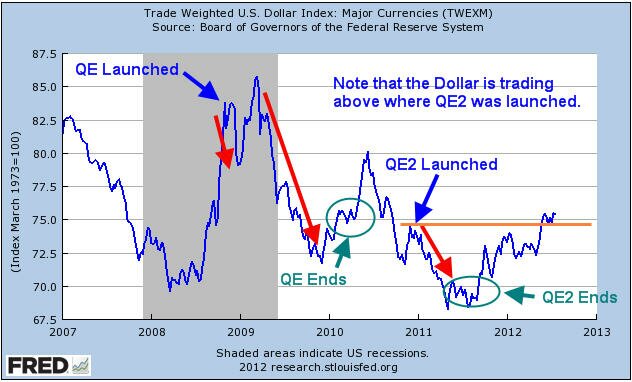
Obviously the price action is pretty clear that Quantitative Easing has a positively correlated impact on the price performance of hard assets, specifically gold and oil. Now consider a price chart of the Dollar Index shown below courtesy of the Federal Reserve Bank, the annotations are mine.
Quantitative Easing Effects
The chart above tells an interesting story about the impact that Quantitative Easing has on the Dollar. How can the Federal Reserve claim to be protecting the purchasing power of the U.S. Dollar when its actions have a direct negative correlation to the greenback’s price?
Furthermore, based on the chart above I am of the opinion that Quantitative Easing III is a foregone conclusion. The current price of the Dollar Index is clearly above the previous high where QE2 was launched. So far, the rally in the Dollar Index has not pushed equity prices considerably lower. However, should the Federal Reserve refrain from initiating additional easing measures it is likely based on the chart above that the U.S. Dollar Index will rally.
Upon the conclusion of both QE and QE2, the Dollar Index rallied sharply higher. With the Fed announcement coming closer by the hour, financial pundits will attempt to predict the future action of the Fed.
I have no interest in making predictions about what the Fed will do. It is a certainty that QE3 will take place at some point in the future whether it be sooner or later. The Federal Reserve simply has no choice, otherwise the Dollar would continue to rally and we would begin to go through a deflationary period which the Federal Reserve simply cannot tolerate.
The scenario that I would urge inquiring minds to consider would be as follows. If the Fed does nothing we can likely assume that the U.S. Dollar Index will continue to rally to the upside. Based on the price chart of the U.S. Dollar Index shown above, we can expect that sellers would certainly step in around the 86 – 88 price range based on previous resistance.
If the U.S. Dollar makes it anywhere near the 86 – 88 price range without the Federal Reserve initiating QE3 it would be expected that risk assets would be under considerable selling pressure somewhere along the way. Should the Fed act to break the Dollar’s rally either through more easing or “other” mechanisms, the result would be a potentially monster rally for risk assets, at least initially.
Equities, oil, and precious metals would rally on a falling Dollar as shown above. The question then becomes what if this is the last gasp rally before a monster selloff ensues in the Dollar Index?
If the Fed breaks the rally early or initiates a monster-sized easing program, the initial reaction will be quite positive, especially for equities. As the selloff in the Dollar Index worsens, equities would eventually begin to underperform as oil prices would surge putting pressure on the economy.
In addition to oil rallying on the weaker Dollar, we could also see sellers start to show up in droves dumping U.S. Treasury’s to any buyer left standing. International debt holders would especially have incentive to sell Treasury’s as the real purchasing power of the bonds’ interest payments would decline as the Dollar fell in value.
The way I see it, whether the Fed launches QE3 now or later, the outcome will not change. An extremely weak Dollar could wreak havoc across a variety of assets and the broader economy. Imagine where gasoline prices would be if oil prices hit $125 / barrel. The average price in the U.S. would be well above $5 / gallon based on current prices and possibly higher.
What happens to the economy if interest rates start to react violently to the price action in the Dollar? What if Treasury’s start to sell off viciously and interest rates start to rise wildly and volatility among bond holdings runs rampant? Are we to believe that the very entity that has created boom and bust cycles through easy monetary policies and has been oblivious to the bubbles that it has created is capable of solving the issues that would potentially arise from a currency crash in the U.S. Dollar?
The track record of the Federal Reserve is quite clear. They are generally late to the party and rarely are able to forecast events in the future with any clarity. Do you really think they will know what to do? The free market wants to destroy debt through deflationary pressure and price discovery and the Federal Reserve continues to get in the way.
The free market will win as it always does, but the American people will lose. This process may take months, years, or even decades to play out. Eventually the game will end. There is only one certainty should any portion of the scenario discussed above come to fruition, when the Dollar is inevitably broken the only safe place to hide during the potential currency crash will be in physical gold and silver. Paper money and paper assets will come under extreme selling pressure and in some cases will simply........disappear.
Here’s to hoping I am totally wrong!
Test drive our video analysis and trade idea service for only $1 at www.Trader Video Playbook.com


Get our Free Trading Videos, Lessons and eBook today!

Wednesday, July 25, 2012

How To Position Yourself for a 10 Year Pattern Breakout

As mentioned last Friday just before things took a dive on the weekend, a look at the major market indices did not look promising. If we take an even longer term look and examine the monthly charts we can see that The S&P 500 as well as the Dow Jones have been approaching multi decade rising channel resistance lines. Further, they also appear to be forming bearish rising wedge patterns.

Monthly Long Term Chart Analysis & Thoughts....

As many of my longer term subscribers can attest to, I always preach that technical analysis is one part art and one part science: you can never be completely certain on what the outcome of a pattern is going to be. However, we can use historical analysis to make better investments. The great American Novelist Mark Twain probably said it best in that “history does not repeat itself, but it rhymes”. Regarding a rising wedge pattern, we know that roughly two thirds of the time they will break to the downside. This also means that one third of the time they break to the upside.

In accomplishing our goal of capital growth we must do a number of things. We must make returns on our investments, we must protect our investments, and we must limit our losses. While all three aspects work in tandem with each other, there are times when focus must be allocated to one specific approach.

Regarding the current technical setup, I’m not so focused on the 67% chance that these wedges will break to the downside, but more so the impact of each outcome on the average Joe’s portfolio and mom and pop businesses. The S&P 500 and the Dow are approaching long term resistance lines that have been in place for decades. If we do break to the downside, which I suspect we will, there could be a very significant sell off with consequences that no one can predict at this point though I mention some things in the chart above. Alternatively, there is significant overhead resistance in the various indices, and I don’t believe an upside break would be too monumental.

That being said, I always like to keep an open outlook and wait for the right opportunity. I’m trying to think of scenarios that would prelude further upside action and I really am not coming up with much. As evidenced by the completion of the recent 5 wave uptrend on the S&P that coincided nicely with the various quantitative easing policies, Ben Bernanke and the fed have had less and less impact. I truly can’t see many fiscal developments that would prompt any significant bullish action.

The only scenario I really think that could pump up equities is a series of positive earnings announcements. A lot of expectations, earnings numbers, guidance, etc… have been revised downwards over the last couple of quarters, so there is the opportunity for some positive surprises that could lead to some bullish price action. In absence of such a scenario, I really can’t think of much else that would prompt a run up.

Look at these charts of positive and negative earnings surprises… and the dates and remember what happened following this negative data....

Positive Earnings Surprise


Negative Earnings Surprise


That being said, I am recommending two courses of action. For those steadfast bulls, lock in some profits and/or buy some protection. Missing out on some of the upside is a lot better than losing some of the gains you have fought so hard for over the past couple of years. For the more aggressive traders and investors, start following my updates a little more regularly as I foresee many shorting opportunities coming up in the future. As many of you know, sell offs are often quick and abrupt, and timing is extremely important when playing the downside.

Further, trading could get very volatile in the near future. Historically, and even more so looking forward as August and September have been very costly for the average investor. Our focus will be in taking the highest probability trades that offer the best risk to reward scenarios. There will be times when we miss trades, and times when they’re not timed perfectly. But, as those who have been with me for a while can attest to, patience pays off in the long run....

Join my Free Market Analysis & Trade Idea Newsletter > Now at The Gold & Oil Guy

Chris Vermeulen

Get our Free Trading Videos, Lessons and eBook today!

Saturday, July 21, 2012

Put Your Seatbelts On, It’s About To Get Bumpy!

It was just about a year ago today when the S&P was sitting at fresh highs and everyone was enjoying a rather upbeat summer. It was a nice summer, the markets were calm, and there was a surreal sense of optimism. Then, in the matter of a few days, things got real ugly, real quickly.

Well, it doesn’t seem like too much has changed since then. We’ve had mixed earnings reports, ever evolving worries in Europe, and the always looming fiscal mess in the U.S. Once again, are we in the calm before the storm?

It looks like things in Europe may start to heat up again. Riots turned violent again in Spain as protestors took to the street over austerity measures. With seemingly no resolution, a sinking tourism industry in the PIGS, and a typically hot summer August on its way, all signs point to further turmoil.

Technically, we’re currently seeing a number of bearish indicators setting up in the S&P and other markets. First, on the weekly chart of the SP500 Futures we can see what appears to be a bear flag formation developing. Note the recent rise in price since the beginning of June on decreasing volume.


Weekly SP500 Futures Chart Patterns


Daily Chart Elliott Wave Count For SP500

A second look at the S&P daily illustrates a down trend and 5 wave count bounce in the market, both are currently pointing to lower prices.

>> Completion of two intermediate cycles within longer term 5 wave pattern

>> Downwards wave one from April until beginning of June followed by wave 2 correction from June until present.

The wave two correction typically proceeds the longest wave, wave three, which is pointing towards a large move down (Note that in the first shorter term cycle the downwards wave three was the longest by far. We expect the same to be repeated in the longer term cycle.)


SP500 BIG PICTURE Wave Count

A look at the longer term view once again using the weekly chart, again supports our argument for a major correction. We have just completed a 5 wave pattern since the 2009 lows, and it is looking more like a big pull back is due. Remember most major trends end after the fifth wave.


Copper Weekly Chart Patterns

If we take a look at the copper ETF, “JJC”, we are provided with further justification. Copper is often referred to as “Dr.Copper” due to its industrial application and is known to be a leading indicator for equity markets. Copper has significantly underperformed equity markets and is likely leading the next move down. A look at the weekly chart which points to a rather dismal outlook. There is a major head and shoulder patterns developing.


Major Market Pattern Analysis Conclusion:

Last summer turned into a bloodbath with nothing but red candlesticks taking stocks and commodities sharply lower. If you haven’t already, it’s time to lock in some profits. Short, intermediate, and long term cycles are pointing down, and the increasingly bearish technical developments cannot be ignored. We’ll be looking at entering multiple shorts potentially in the very near future once/if setups present themselves.

 Buckle up and stay tune for more....


Stay in the loop by joining my free weekly newsletter
& videos to stay ahead of the crowd. 

Click here to visit The Gold & Oil Guy.com


Get our Free Trading Videos, Lessons and eBook today!

Monday, July 2, 2012

Don't Miss our Holiday Special....Ends July 6th at Midnight!


Ready for the next market move?  Click Here for this weeks Special

Beat the street with our low risk ETF trading signals

Member Benefits Include

Low risk ETF trades
Entry, Target and Stops
Holding times 2 to 30 days
Position Money Management
Intraday Market Updates
Special Sector Analysis
Educational Trading Videos
Trading Guide
Unlimited Email Support
401K, IRA and RSP Tradable
Alerts Via Web and Email


Just remember to enter code july12for6
to get the 12 membership for the price of 6 months


Monday, May 21, 2012

Todd’s Secret Weapon, the 30 Minute Breakout Strategy

It was American writer Orison Swett Marden who observed, “A good system shortens the road to the goal.”

If you have a trading goal, but the lack a proven system for getting there, grab veteran trader Todd Mitchell’s step by step blueprint for setting up a profitable trade right now.

Get Todd's "30 Minute E-Mini Breakout, valued at $497"

He’s fine tuned and perfected a system for making money during just the first 30 minutes of the trading day. Yes, only 30 minutes....Please don’t miss out on this.

If you visit this website right now, you can download this strategy at no cost to you whatsoever. Everything you will need to know about trading this strategy is revealed to you. Nothing is being held back.

Take a few minutes to just click here and watch the 30 Minute E-Mini Breakout video and see what I mean.

Todd Mitchell is only making this free report and trading tutorial available for a limited time.

Get the free strategy now ... trade it tomorrow.

Monday, May 7, 2012

The Dollar and Manipulation Control the Market

Over the weekend I had an interesting conversation with a local trader. We typically meet a few times a year to share our market outlooks, new trading tools and techniques, and usually finish our session off in a debate about the US market manipulation and how to trade around it.

Talking about market manipulation always opens up a can of worms and sparks some interesting theories… And while everyone has their own views and opinion on this subject I thought I would briefly share the main points I pulled from our conversation.

I did talk about the dollar index last week, but the recent price action unfolding today is important so I’m going to recap on it again.

My Weekend Conversation Key Thoughts:

Point form thoughts supporting Lower Equity prices and a Higher Dollar:
-          Dollar index looks ready for a major rally (high dollar means lower stocks)
-          SP500 may have just formed a double top
-          SP500 closed strongly below the 20 day moving average
-          First week of May for the past two years have been intermediate market tops

Points supporting Higher Equity prices and a Lower Dollar:

   Countries around the globe are trying to keep their currency value low including the United States.

   Presidential cycle strongly favors higher stocks prices which means the dollar should not rally until Nov.

   What do all these points mean? Let’s take a look at the dollar charts below…

4 Hour Dollar Index Chart:

This chart time frame allows us to see all intraday price action while being able to zoom out several months for patterns along with key support and resistance levels.

As you can see over the past few months the dollar has been consolidating sideways. Within this consolidation it has formed two bullish falling wedges with the most recent one breakout last week right on queue.

Using this 24 hour futures dollar index chart we can see where things are trading through the weekend. On Friday the dollar index closed around the 79.50 level. As you can see the dollar has surged Sunday night by more than half a penny breaking through its down trend line.

The next few weeks will continue to be exciting ones as strong moves in the dollar will create wild movements in stocks and commodities.


Long Term Weekly Dollar Index Chart:

If you zoom WAY OUT using the weekly chart this shows you the two major areas where the dollar index is likely to reach come November. Also with these levels are my SP500 price points which are simply numbers I pulled from the charts using basic analysis. I say this because I’m not into long term forecasting but rather shorter term price movements. A lot can change between now and then.

So, if the dollar index rallies to the 86 – 88 level then I would expect the SP500 to be trading back down at the 1000 level. If this takes place, the Fed will likely issue QE3 to jam the dollar back down and boost equities.

The flip side of the coin is that the dollar rolls over here and gets pulled down. This will boost stock prices in favor for the president’s election. After that the dollar would likely rally which in turn would put a major top in the stock market, kick starting a bear market.


The big question…

Do you short the market in anticipation of rising dollar and falling stock prices? OR do you buck the trend and stick with the theory of a lower dollar value and presidential cycle?

The charts above clearly show how we are entering a major tipping point for the market and the next couple months are likely going to provide some big price swings for stocks, commodities and currencies.

If you want to get my thoughts and market ideas each morning before the opening bell be sure to join my video newsletter The Gold & Oil Guy.com

Chris Vermeulen

Sunday, May 6, 2012

The Dollar & Gold Have Eyes on Europe

Friday saw heavy selling pressure coming into risk assets, specifically equities and oil. However, the real driving force behind the selling pressure is likely the result of several unrelated economic/geopolitical events. Clearly the unemployment report had an impact on price action, but strangely enough it would appear to those more in tune with reality that market participants want lower prices so that the next quantitative easing program can be initiated.


Another key development in equities price action as of late has been selling pressure in Apple (AAPL). A few weeks ago we witnessed a sharp downturn after prices surged higher into a blowoff top. Earnings came out and prices jumped again and we have watched Apple’s stock price drop considerably since.
Friday saw sellers circling the wagons pushing the tech behemoth down around 2.25% as of the scribbling of this article. When AAPL was rallying it helped the Nasdaq Composite and the S&P 500 grind higher. Now that it has clearly given up the bullish leadership role, it now appears to be a drag on the price action of domestic indices.
Additionally there was a mountain of economic data released out of Europe overnight which was entirely negative. Spain, Italy, France, Germany, and the Euro-area in general saw their Service PMI readings all come in below expectations. Europe is moving into a recession which whether economists want to acknowledge it or not has implications on domestic U.S. markets. The Eurozone as a whole is the largest economy in the world. Clearly the European economy is slowing, and our exports to Europe will slow as well.
This leads me to the final data point which is still unknown. What will the outcome of the French and Greek elections over the weekend mean for the Eurozone’s geopolitical ties as well as the potential impact on the Euro currency itself?
The answer to that question will likely not be known until late Sunday evening; however by the time U.S. markets open this coming Monday the cat(s) will be out of the bag. This final question leads me to the real topic of this article. The question I want to know is what impact these elections could have on the value of the U.S. Dollar Index as well as gold?
As an option trader, I am always focused on the volatility index (VIX) as well as implied volatility on a number of underlying assets. I came across the following chart courtesy of Bloomberg which appeared in an article posted on zerohedge.com. The chart below illustrates the differential between European Union equities’ implied volatility levels and the EUR/USD currency pair.
Currency Trading
Chart Courtesy of Bloomberg
It is rather obvious that EU stocks and the EUR/USD implied volatility levels have diverged. Generally speaking, when volatility increases it means that price action will typically move lower. The higher levels of volatility, the lower the price the underlying will move. There are exceptions to that rule such as earnings reports or key headlines which drive volatility higher, but generally speaking high volatility levels correlate with uncertainty and risk.
What is particularly troubling about the chart above is that the EUR/USD currency pair is seeing reduced implied volatility. This essentially means that the market is not expecting any major moves in the currency pair amid all of the poor economic numbers coming out of Europe.
For those not familiar, the EUR/USD currency pair reflects the value of the Euro against the Dollar. Thus, if the EUR/USD is rising, this means that the Euro is moving higher against the Dollar. The opposite is true when EUR/USD is selling off.
At present implied volatility levels are quite low by comparison to European equities. The zerohedge.com article entitled “Is EURUSD Volatility About to Explode?” shares the following statement to readers, “The last two times this has occurred (in the last year), EURUSD implied vol has rapidly caught up to equity’s risk.”
What that statement means is that it is becoming more likely that implied volatility of the EUR/USD currency pair is going to increase back in par with European stocks. If that takes place, which based on recent data is likely, the intraday volatility in the EUR/USD will increase thus intraday price ranges and sharp moves will become more prevalent.
The long story short is if implied volatility picks up in EUR/USD then it is likely going to be quite beneficial to the U.S. Dollar. The largest concern for Fed Chairman Ben Bernanke has to be the potential for a monstrous move higher in the U.S. Dollar should an unforeseen event arise in Europe. An event such as a disastrous auction or the discussion by German Parliament about leaving the Euro could both help push the Dollar much higher than anyone expects.
A higher Dollar is negative for risk assets and Mr. Bernanke does not like the word deflation at all. None of the central banks around the world like deflation because it means all of the debt they are holding and helping to prop up has a much more significant intrinsic value. If the Dollar is worth more, Dollar denominated debt is also more expensive to pay off.
The U.S. Dollar Index has languished for several weeks, but recently the greenback started to reverse higher and at this time has managed to push above major resistance levels overhead on the daily timeframe. The daily chart of the U.S. Dollar Index is shown below.
US Dollar Trading
If the Dollar remains firm into the bell on Friday which appears likely, the results of the two key European elections over the weekend could provide the ammo needed to really force the U.S. Dollar higher or lower depending on market sentiment. It appears the Dollar wants to go higher currently, but a sharp reversal is not out of the question.
The key level to watch is the 80.76 price level on the U.S. Dollar Index futures. If that level gets taken out, the Dollar could extend to recent highs and beyond should the situation in Europe begin to unravel.
If the Dollar surges what will that mean for gold? Generally speaking most readers would expect gold and silver to move lower on Dollar strength. For a time, that would likely be true, but if a real currency crisis plays out gold and the Dollar might rally together as citizens would try to move their wealth into safe, liquid assets.
Under that type of scenario, gold and silver could both rally along with the Dollar. When the moment finally arrives where the Euro begins to selloff sharply, physical gold and silver will be tough to acquire in Europe.
In the short to intermediate term, gold will likely continue to drift lower searching for a critical bottom. The weekly chart of gold futures below demonstrates the key support and resistance levels that may have to be tested before a major reversal can play out.
Gold Trading
Make no mistake, I remain a gold bull in the long term. However, in the short run the Dollar has the potential to outperform gold under the right circumstances. Ultimately it is important to recognize the distinction between selling pressure and what would likely happen in a full blown currency crisis in Europe which is possible, if not ultimately inevitable.
The price action over the weekend on Monday will likely be telling and we could see the beginning of a major move in a variety of underlying assets depending on the election results. Clearly times have changed when U.S. market participants are concerned about what is going on in Europe more so than domestic issues. Unfortunately, we live in very strange times.

Looking for a Simple ONE Trade Per Week Trading Strategy?
If so, join today and start trading options today!