Showing posts with label banks. Show all posts

Thursday, August 31, 2017

VIX Spikes Showing Massive Volatility Increase

Today, we are going to revisit some of our earlier analysis regarding the VIX and our beloved VIX Spikes.  Over the past 3+ months, we’ve been predicting a number of VIX Spikes based on our research and cycle analysis.  Our original analysis of the VIX Spike patterns has been accurate 3 out of 4 instances (75%).  Our analysis has predicted these spikes within 2 to 4 days of the exact spike date.  The most recent VIX Spike shot up 57% from the VIX lows.  What should we expect in the future?

Well, this is where we should warn you that our analysis is subjective and may not be 100% accurate as we can’t accurately predict what will happen in the future. Our research team at Active Trading Partners.com attempt to find highly correlative trading signals that allow our members to develop trading strategies and allow us to deliver detailed and important analysis of the US and global markets.

The research team at ATP is concerned that massive volatility is creeping back into the global markets. The most recent VIX spike was nearly DOUBLE the size of the previous spike. Even though the US markets are clearly range bound and rotating, we expect them to stay within ranges that would allow for the VIX to gradually increase through a succession of VIX spike patterns in the future.

Let’s review some of our earlier analysis before we attempt to make a case for the future. Our original VIX Spike article indicated we believed a massive VIX spike would happen near June 29th. We warned of this pattern nearly 3 weeks ahead of the spike date. Below, you will see the chart of the VIX and spikes we shared with our members. This forecast was originally created on June 7th and predicted potential spikes on June 9th or 12th and June 29th.


What would you do if you knew these spikes were happening?

Currently, we need to keep in mind the next VIX Spike Dates
Sept 11th or 12th and finally Sept 28th or 29th.

Our continued research has shown that the US markets are setting up for a potential massive Head-n-Shoulders pattern (clearly indicated in this NQ Chart). The basis of this analysis is that the US markets are reacting to Political and Geo-Economic headwinds by stalling/retracing. The rally after the US Presidential election was “elation” regarding possibilities for increased global economic activities. And, as such, we have seen an increase in manufacturing and GDP output over the past 6+ months. Yet, the US and global markets may have jumped the gun a bit and rallied into “hype” setting up a potential corrective move.


Currently, the NQ would have to fall an additional 4.5% to reach the Neck Line of the Head-n-Shoulders formation. One interesting facet of the current NQ chart is that is setting up in a FLAG FORMATION that would indicate a massive breakout/breakdown is imminent. The cycle dates that correspond to this move are the September 11th or 12th move.


Please understand that we are attempting to keep you informed as to the potential for a massive volatility spike in the US and Global markets related to what we believe are eminent Political and Geo-Economic factors. Central Banks have just met in Jackson Hole, WY and have been discussing their next moves as well as the US Fed reducing their balance sheets. Overall, the US economy appears to show some strength, yet as we have shown, delinquencies have started to rise and this is not a positive sign for a mature economic cycle. Expectations are that the US Fed will attempt another one or two rate raises before the end of 2017. Our analysis shows that Janet Yellen should be moving at a snail’s pace at this critical juncture.


The last, most recent, VIX Spike was nearly DOUBLE the size of the previous Spike. This is an anomaly in the sense that the VIX has, with only a few exceptions, continued to contract as the global central banks continued to support the world’s economies. In other words, smooth sailing ahead as long as the global banks were supplying capital for the recovery.

Now that we are at a point where the central banks are attempting to remove capital from their balance sheets while raising rates and dealing with debt issues, the markets are looking at this with a fresh perspective and the VIX is showing us early warning signs that massive volatility may be reentering the global markets. Any future VIX Spike cycles that continue to increase in range would be a clear indication that FEAR is entering the markets again and that debt, contraction and decreased consumer participation are at play.

I don’t expect you to fully understand the chart and analysis below, but the take away is this. Pay attention to these dates: September 11, September 28 and October 16. These are the dates that will likely see increased price volatility associated with them and could prompt some very big moves.


This analysis brings us to an attempt at creating a conclusion for our readers. First, our current analysis of the Head-n-Shoulders pattern in the NQ is still valid. We do not have any indication of a change in trend or analysis at this moment. Thus, we are still operating under the presumption that this pattern will continue to form. Secondly, the current VIX spike aligns perfectly with our analysis that the markets are becoming more volatile as the VIX WEDGE tightens and as the potential for the Head-n-Shoulders pattern extends. Lastly, FEAR and CONCERN has begun to enter the market as we are seeing moves in the Metals and Equities that portend a general weakness by investors.

We will add the following that you won’t likely see from other researchers – the time to act is NOT NOW. Want to know why this is the case and why we believe our analysis will tell us exactly when to act to develop maximum profits from these moves?

Join the Active Trading Partners to learn why and to stay on top of these patterns as they unfold. We’ve been accurate with our VIX Spike predictions and we will soon see how our Head and Shoulders predictions play out. We’ve already alerted you to the new VIX Spike dates (these alone are extremely valuable). We are actively advising our ATP members regarding opportunities and trading signals that we believe will deliver superior profits. Isn’t it time you invested in your future and prepared for these moves?


Join the Active Trading Partners HERE today and Join a team dedicated to your success.


Stock & ETF Trading Signals

Friday, July 1, 2016

Warning: This Could Be the Start of a Global Banking Crisis

By Justin Spittler

Europe’s banking system is collapsing. Over the past year, shares of Deutsche Bank (DB), Germany’s biggest bank, have plunged 56%. Swiss banking giant Credit Suisse (CS) is down 62% over the same period. Yesterday, both stocks hit record lows.

Dozens of other European bank stocks have also crashed. The Euro STOXX Banks, which tracks 48 of Europe’s largest banks, is down 48% over the past year. This is a major issue. That's because banks are the cornerstone of the financial system. They keep money flowing through the economy. If they’re struggling, it often means the economy is having major problems. Right now, European banks are flashing bright warning signs. That’s not just bad news for Europe—it’s also a serious threat to the rest of the world.

In today’s Dispatch, we’ll show you why Europe’s banking crisis could turn into a global banking crisis. You’ll also learn how to transform this threat into a chance to make big gains.

European banks are struggling to make money..…
Spanish banking giant BBVA’s (BBVA) profits fell 54% last quarter. First quarter profits at Deutsche Bank were down 58%. Swiss bank UBS’s (UBS) profits plunged 64%. European banks are hurting for a couple reasons. One, Europe is growing at the slowest pace in decades. Banks are making fewer loans as a result.

Two, negative interest rates are eating European banks alive. If you’ve been reading the Dispatch, you know negative rates are the latest radical government policy. They basically flip your bank account upside down. Instead of earning interest for keeping money in the bank, you pay the bank to hold your money.

Negative rates are clearly bad for savers. They’re also hurting Europe's biggest banks. That’s because these huge institutions have to pay their “bank,” the European Central Bank (ECB). Today, European banks pay £4 for every £1,000 they store at the ECB for a year. That might not sound like a lot. But it adds up quick when you manage trillions of euros like these banks do.

Last week, investors got another reason to avoid European banks..…
On Thursday, Great Britain voted to leave the European Union (EU), which it’s been in since 1973.
The “Brexit,” as the media is calling it, blindsided investors. As we explained yesterday, the market was expecting Great Britain to stay in EU. The unexpected outcome triggered a global stock market crash.

U.S. stocks had their worst day since August. Japanese stocks had their worst day in five years. European stocks had their biggest decline since the 2008 financial crisis. Friday’s global selloff erased $2.1 trillion in value from global stocks. It was the global stock market’s worst day in history. The panic didn’t die down much over the weekend. By the end of Monday, another $930 billion had disappeared from the global stock market.

European bank stocks were hit the hardest..…
Deutsche Bank plunged 22% between Friday and Monday. Credit Suisse fell 23%. UBS fell 20%. Barclays (BCS) and Royal Bank of Scotland (RBS) each plunged 37%. Both stocks are down more than 57% over the past year. These are gigantic moves in a matter of days. Remember, we’re not talking about small biotech stocks. These are some of the most important financial institutions on the planet.

Government officials are scrambling to contain the crisis..…
Today, the Bank of England (BoE) injected £3.1 billion into Britain’s banking system. It’s pledged to inject as much as £250 billion to stabilize its financial system. The BoE made its cash injection hours after the Bank of Japan (BOJ) pumped $1.5 billion into its banking system. As we'll show you in a second, we don't believe this will end well. That's because this excessive money printing (sometimes called "quantitative easing") doesn't stimulate the economy like governments intend it to.

Credit Suisse says other central banks could soon print more money too. Bloomberg Business reported on Friday:
“Market liquidity and overall liquidity in the U.K. is drying up as we speak in a very rapid way,” said John Woods, chief investment officer for Asia-Pacific at Credit Suisse Private Banking, told Bloomberg TV in Hong Kong. “It’s highly likely that we see monetary easing in a coordinated response” from central banks across the world, he said.
Great Britain is headed for a recession..…
A recession is when an economy shrinks two quarters in a row. Goldman Sachs (GS) says Britain could be in a recession by early 2017. But here’s the thing. We don’t think the BoE will let this happen. That’s because central bankers will do anything, including using reckless, unproven monetary policies, to avoid a recession these days.

Credit rating agency Standard & Poor’s agrees with us. Reuters reported today:
"Brexit is likely to represent a drag of about 1.2 percent of GDP for the UK in 2017," Jean-Michel Six, S&P's chief economist for Europe, the Middle East and Africa told a conference call for investors on Tuesday. "We have a significant slowdown but growth remains positive although obviously in a much more disappointing way. That is because we anticipate a very strong monetary response on the part of the Bank of England, in the form of additional quantitative easing, in the form of a further cut in interest rates," he added.
Bank of America (BAC) and Deutsche Bank also expect the BoE to fire up the printing press again. Bank of America says it could happen as soon as August.

QE won’t help Great Britain’s economy..…
As we told you above, QE doesn’t work. As regular readers know, the Federal Reserve pumped $3.5 trillion into the U.S financial system after the 2008 financial crisis. This massive money printing effort was supposed to juice the economy. But the U.S. is growing at its slowest pace since World War II. QE also failed to jumpstart Japan’s economy, which hasn’t grown in two decades. There’s no reason to think it will work this time.

If you’re nervous about the global financial system, we encourage you to take action today.…
The first thing you should do is own physical gold. Gold is real money. It’s held its value for thousands of years because it has a unique set of attributes: It’s easy to transport, easily divisible, and durable. You can take a gold coin anywhere in the world and folks will immediately recognize its value.

Unlike paper money, central bankers cannot create gold from nothing. It’s the ultimate antidote to crumbling paper currencies. That’s why the price of gold often soars when governments print money. This year, gold is up 24%. It’s trading at the highest price in two years. But it could go much higher as governments continue to run reckless monetary experiments.

If you want big profits from rising gold prices, own gold stocks..…
Dispatch readers know gold miners are leveraged to the price of gold. A small jump in the price of gold can cause gold stocks to surge. Gold’s 24% jump this year has caused GDX, a fund that tracks large gold stocks, to soar 96%. We believe this gold stock rally is just getting started. During the 2000 and 2003 gold bull market, the average gold stock gained 602%. The best ones soared 1,000% or more.

Nick Giambruno, editor of Crisis Investing, has recommended two gold stocks this year..…
He already closed out one of them for a quick double. It surged 103% in 14 months. Nick’s other gold stock is up 30% since March and is still dirt cheap at today's levels. Nick currently rates this stock a "Buy"…and says it could soon start paying a double digit dividend yield if gold keeps rising.

You can learn more about Nick’s gold stock by taking advantage of our special 60%-off sale for Crisis Investing. If you sign up today, you’ll be enrolled in a trial membership, which gives you 90 days risk-free to decide if the service is for you. But we encourage you to act soon. This special offer ends soon, and we likely won’t open this offer again for a long time.

You can learn more about this incredible offer by watching this video presentation. You’ll also learn about an even bigger threat to your wealth than Europe’s banking crisis. As you’ll see, almost no one is talking about this coming crisis. Yet, it could cause millions of Americans to lose their entire life savings. By the end of this video, you’ll know how to protect yourself. And just as importantly, you’ll know how to profit from this coming crisis. Click here to watch this free video.

Chart of the Day

U.S. bank stocks are also headed lower. Today’s chart shows the performance of the Financial Select Sector SPDR ETF (XLF) over the past year. XLF holds 94 major U.S. financial companies including behemoths JPMorgan Chase (JPM), Wells Fargo (WFC), and Bank of America (BAC). You can see XLF is down 11% since last June. While that's not as severe as the near 50% drop in European banks over the same period, it's still a clear sign to stay away.

U.S. banks have many of the same problems as European banks. Like Europe, the U.S. economy is growing at the slowest pace in decades. And while the U.S. economy doesn’t have negative rates yet, Fed Chair Janet Yellen has said they aren’t “off the table” if the U.S. economy runs into trouble. The arrival of negative rates to the U.S. could tip bank stocks into a crisis, just like they have in Europe.


Get our latest FREE eBook "Understanding Options"....Just Click Here!

Stock & ETF Trading Signals

Thursday, October 16, 2014

How Can There Not Be a Currency Crisis?

By Casey Research

The Fed claims that signs of economic stress are very low, but savvy investors feel otherwise. With geopolitical unrest expanding and central banks doing the opposite of the right things, is a currency crisis barreling toward us? See what Mish Shedlock had to say about the state of world finance at the 2014 Casey Research Summit:


Even though the Summit is long over, you can still benefit from every presenter… every panel discussion… every investment recommendation. Order the 2014 Summit Audio Collection and you’ll receive all of that, plus all slides used in the presentations and a bonus highlight reel. Choose between instantly available MP3 files or CDs… or get both for maximum convenience.

Order now so that you’re well positioned to thrive in the coming crisis economy.

The article How Can There Not Be a Currency Crisis? was originally published at casey research


Get out latest FREE eBooK "Understanding Options"....Just Click Here

Sunday, June 8, 2014

Are You Ready for Negative Interest Rate and Pay the Bank to Hold Your Money?

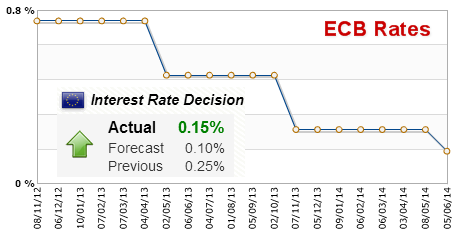
The six members of the European Central Bank (ECB) Executive Board and the 16 governors of the euro area central banks vote on where to set the rate. We watch interest rate changes closely as short term interest rates are the primary factor in currency valuation.
 

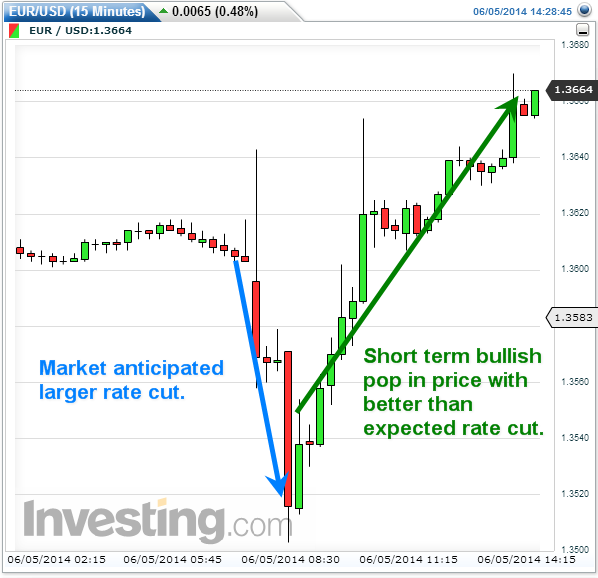
A higher than expected rate is positive for the EUR, while a lower than expected rate is negative for the EUR. Today (Thursday June 5th) we expected a rate cut. The cut was not as much as analysts expected which is bullish for the short term, but the rate is still declining and nearing zero, or even worse, negative territory.


ecbrates eurochart


A negative interest rate may sound crazy or impossible, but it's already happening in Denmark. Europe is already in a deflationary state and central banks are doing everything they can to bring about inflation by cutting rates and devaluing the euro. This will cause a ripple through multiple asset classes and will drastically alter the outcome of individuals worldwide. Just imagine if you had to pay a bank to hold your money and you do not earn any interest but rather pay interest.

People who have been saving their entire lives will get hit the hardest. Retired folks will stop earning money and start paying for all the money they hold held at banks. Individuals will go more into debt because money will be extremely cheap to borrow. Price of assets like equities, real estate, discretionary goods will rise because the cheap money everyone is borrowing will be used to buy more stuff. While all this happens everyone takes on more dept. It is a brutal spiral leading to increase debt levels, inflation and eventually bankruptcy.

If the euro dollar starts to decline at a quicker pace the U.S. dollar will likely rally. A strong dollar could affect the commodities market including gold, silver and the European stock markets. Todays rate cut led to a pop in the euro, but that is likely to be short lived. I hope this sheds some light on the markets and helps in your trading.

Chris Vermeulen

P.S. In the next few days members and myself will be looking to enter some trades based round this analysis. See Premium Trading Video & Newsletter

Sincerely,
Chris Vermeulen


Sign up for one of our Free Trading Webinars....Just Click Here!


Monday, May 5, 2014

A Yen for a Mortgage

By John Mauldin

For some time I have been saying that I was going to close the mortgage on my new apartment and then hedge it in yen. I promised to tell you the story, including what type of loan I got and how I am doing the hedge. This week I was finally able to pull the trigger. This topic will also let us re-examine why I think the Japanese yen is a screaming short. I am going to make this a shorter letter, as Amsterdam is calling, and it is a beautiful day. This is not a big think piece, but I think many of you will find it interesting. It outlines how I put my economic thinking into actual practice, and names names, if you will, of those who helped me do it.

A little background might be in order for those who want to know about the house. Others might skip to the next heading, An ARM and a Leg. I bought my last home in 1991 and sold it around 1998. I bought during the savings and loan crisis, which gave us the Resolution Trust Corporation, which sold me my hew home. I paid about 35% of the original asking price only two years earlier, at the high water mark, so I got a good deal. (Which was partially offset by the fact that I had to bring a check to the closing from the home I sold to get the new one.) Homes in some parts of Texas were literally being auctioned on the courthouse steps and paid for with credit cards.

For that home, I actually offered $50,000 less than several other offers on the table, but I attached a large nonrefundable cashier’s check, as a deposit, to the offer, while other bidders wanted the harried RTC clerk to make some much-needed repairs (the pool was green, fire ants had chewed through wiring, there had been flooding, etc.). But he had a monster stack of homes on his desk to sell, and my offer involved the least work, so he simply took it. I didn’t make all that much when I sold the home seven years later, by the way, but I did OK.

Rental properties in Texas at that time and up until recently have been good deals, in my opinion. For me, the cost of renting was much lower than the total cost of buying a home. About six years ago I moved to downtown Dallas after 40 years on the Fort Worth side of the metroplex. I moved first into a high rise (with some of the kids) and then later rented a larger home in Highland Park during the Great Recession, when larger homes simply couldn’t find buyers. It was stunningly cheap for the value. I was quite happy with my long term set up, but in January the owner called from California and offered to let me out of my lease if I would move in 45 days so he could sell the home in the spring. The market had finally come back, and homes in the “Park Cities” were selling within a few weeks of going on the market.

I was not really interesting in moving, but I had been to an apartment that a good friend of mine (David Tice of Prudent Bear fame) had renovated, in what is called the Uptown area of Dallas. He bought two apartments on the 22nd floor of a high rise, basically taking the whole south side, then knocked down interior walls and made one large, open apartment He really did it quite nicely. I fell in love with his place, which is rather unusual for me, as I have been in fabulous homes all over the world; and while I admired many of them, none had ever “spoken” to me. But the views of downtown Dallas and the surrounding area just seemed so full of energy to me; and as a writer, I need to feel the energy. It recharges me. (I know, some people want beaches or mountains or a cave, and I have written this letter from many corners of the planet, but I do like a place with energy.)

So I called David’s realtor. Amazingly, two adjoining apartments were just coming on the market. They were basically apartments that had been bought on spec during the crisis, and the market had now come back enough that the owners were ready to sell. One of the apartments had never been lived in or rented. They were the two three bedroom apartments on the east side of the building, but they had the downtown views as well as northern ones.

Dallas has plenty of high rises, but oddly there are very few larger apartments except for penthouses. And the penthouses command a LARGE premium for what is still just basically floor space. I checked all the local similar offerings to get an idea of relative value, and I again put in a below market offer for the two apartments. After a lot of negotiating by my realtor, Nancy Guerriero, my offer was accepted. Then the hard part began, and that was getting a mortgage. Because I was going to renovate and because there was a tenant in one of the apartments, I could not get anything like a traditional mortgage. My mortgage broker, Ron Schulz, must have shopped several dozen banks. Basically, banks don’t like high rises and homeowners’ associations, as their local experience has not been good. Without going into details, I had to get three different loans to do the deal, and finally got help from a local banker, Joe Goyne, president of Pegasus Bank. Joe is a throwback to the old personal bankers we used to have here in Texas.

We started on the design almost as soon as I committed to the place. I was lucky in that my niece, Jen Mauldin, had trained with one of the largest architectural design firms in the country and done major design projects all over the world (the estates of Abu Dhabi princes, commercial developments in Macau, high roller suites in Vegas, Ritz Carltons, etc., plus lots of very nice homes). She had gone out on her own and was available. We set budgets and timelines. (Cue laughing from all my friends. They were right to laugh.) The planned 120 days of construction stretched into 180+ days – and forget about the budgets. Then there was the shock when it developed that new mortgage rules basically meant that I had to go to a 70% loan instead of the 80% I had been told I would get.

Plus, I was a rookie and did not check a “small” detail. I asked if I could get my construction costs rolled into the new loan. The answer was yes, but what they meant was that I could get the construction loans rolled in but not my out-of-pocket costs, because Texas has a law that you cannot get money out of your mortgage when you refinance, and what I paid out of pocket was considered getting money back. Oops – I had paid a lot out of pocket just to move things along, when I should have gone to Joe and upped my construction loan. Silly me.

All told, I had to come up with way more cash than I thought I would when I started. The difference was large enough that I would not have done the deal if I had known. But I really like my place, so in a sense I am glad that I didn’t know. (You can see some of the work on the place at Jen’s website.)

An ARM and a Leg 

But then came the time to get a takeout mortgage. Joe had lent me the total amount at 3.75% for one year.
It soon became apparent I would get only a 70% loan, which would basically take me out of the construction loans. I got lucky in that the appraisals turned out higher than my cost basis, as values have actually moved up. First feelers were not encouraging, so I began to shop.

I wanted a 5 year adjustable-rate mortgage (ARM) with a 30 year amortization. My feeling is that there will be a recession within the next five years (if we do not have one, it will be the longest span on record with no recession in the US) and that rates will once more go way down – and I can then lock in whatever I want, probably a 15 year fixed, at that time. My risk is that we may never again see rates as low as they are today, but that is a chance I am prepared to take. (I really do eat my own “cooking.”)

Two personal connections turned up offers in the 4.5% range. Ron was beginning to get feelers in the high 3% range. I called my broker at JP Morgan (more below), and Travis Moss in his office went to work and got me an offer for the 5 year ARM at 2.875%; but it was not clear they could actually do the deal, as high-rise financing is complicated in Texas. About that time, my regular bank, Capital One, changed loan officers. The new guy gave me a courtesy call; and upon finding that I needed a mortgage, he jumped into the process. Rather than a loan that they would securitize, they were looking for a loan to put on the books.

They matched the JP Morgan offer and really dropped the closing costs. No points, etc. I sheepishly told Travis (who is a friend) that I was getting a better offer, and within a day he had matched it. We decided to go with JP Morgan, as that is where I am going to do my yen hedge, but it was hard to turn down Clinton Coe from Capital One. He really wanted that loan. When we had our crisis in Texas back in the early ’90s, we “lost” our banks to national banks and lost a lot of that personal touch I had known for the first part of my career. It is nice to see bankers like that again in Texas.

I signed the closing papers and had literally just stood up from the table when I took a call from the banker at Capital One, offering to cut the rate to 2.75% and axe a few other costs as well. WOW. Now, in Texas you can cancel a loan commitment for up to three days. I was tempted for a minute, but decided that because I had told Travis I would do the deal, I was not willing to take that back. But I did call Travis and tell him what had happened, joking about it. He said “wait a minute.” He hung up, then quickly called me back and said, “We will match it. Go cancel your loan.” When was the last time your banker tore up your loan and then lowered the rate for you five minutes after you signed the deal?

So I rescinded the first loan and then had to wait another 30 days (the rules) but finally closed on the way to the airport to come to Amsterdam.

A Yen for Mortgages

Long-time readers know I am a huge bear on the relative value of the Japanese yen versus almost any currency, but especially the dollar. I have been saying for some time that I expect the yen to one day be at 200 and maybe even higher. But that journey is going to take a long time. Forty years ago the yen was at 357 (or thereabouts), and then it rose over time to the high ’70s last year, when it started to fall again. The chart below goes back 43 years. Think, by the way, how your businesses would react if the value of the currency in which you trade rose by a factor of four over 40 years.


Later in the letter I will go more into my reasoning as to why I think the yen will fall over time, but for now let’s look at how I got a “yen mortgage.”

I asked readers to help me find a “pure” yen mortgage. I said I thought the market for such a mortgage would be huge, and I would help build it. I must admit, I was somewhat surprised when nothing really turned up. Ten year government paper in Japan is at 0.6%. You would think that getting 2% for a 15 year mortgage would appeal to someone, but running a few connections still brought me nothing. I even found a U.S. bank that would agree to a takeout and mortgage guarantee, but still no takers. I guess a billion isn’t as big a deal as it used to be.

The basic concept is that if the yen falls by 50% (my bet) and I have my loan structured in yen, then I pay less in dollars. Perhaps a lot less. But since no pure yen loan is available that I can find, a synthetic one will have to do.

There are lots of ways to do it. Futures are the obvious way – simply selling the yen short. But I have no way of knowing timing on the yen, and in my view there will be some significant “corrections” along the way, so using futures would be a constant battle of margins, rolling into forwards, paying commissions with every new contract, etc. And given the new Dodd-Frank rules, it is #$%W$#$ hard to simply tell a broker to execute a trade. To do the trade I ended up doing (see below), I had to be on the phone in the middle of the Amsterdam night to verbally confirm that I was sane and really, really did want to do the trade. But given my travel schedule and possible technological issues, updating my futures trade could have been problematic.

So I elected to keep it simple and do a 10 year put option. I want Abe-san and Kuroda-san to pay for about half my mortgage. I will gladly pay the other half. All they have to do is print yen to fulfill their part of the transaction – and they seem pretty committed.

Warning: Don’t try this at home, kids. This is a VERY risky bet, even though my losses are limited to my entire investment. And while my logic might be compelling, at the end of the day I am trading/betting/gambling (all essentially the same thing) that politicians in a country and a culture I don’t live in and don’t truly understand are going to act in a certain way. They might choose another path with different disastrous results that would make the trade go against me. They have no good choices, only disastrous ones, because they have overleveraged their government and cannot possibly meet their obligations without some kind of default. Rather than outright default to their own retirees, I think they will print and inflate and monetize away that debt. But that’s just me making a trade to counter what I think they will do (and what they tell us they will do). With that preface, let’s look at what I am doing.

To execute the trade, I went to The Plumber. That is my rather affectionate name for Erick Kuebler, a JP Morgan broker here in Dallas. Darrell Cain introduced us, with a rather effusive (for Darrell) endorsement. Having met a few brokers over the years, including some really good ones, I just listened and watched. But as Erick is part of that downtown TCU-grad mafia (a local thing – he was in the same frat with Kyle Bass and a group of guys), he kept showing up at places where I was.

Over time, I realized that Erick understood the workings of the market better than anyone I personally knew. Not the normal things you and I think about, but what really happens when you execute a trade. I simply want to go to a screen and buy or sell, in much the same way that I go to a faucet and turn it on and get water. I expect water to come out when I twist the handle.

The Plumber knows what happens when I do that. He knows where the water comes from, who purifies it, what tank it was stored in before it got to me, whether it will be hot or cold, and what the pressure is. He knows whether to use copper or PVC pipe in the construction. He knows who charges what at each step along the line. I have learned a lot from The Plumber. (Simple ETF trades, for instance, are not all that simple. Especially in size.) For the record, I am a registered broker with my own firm, and you would think I would know this stuff. I kind of knew but had no real idea how many toll gates there are if you are not paying attention. Erick specializes in larger trades for clients trying to avoid those tolls. He laughs at the HFT guys.

Plus, Darrell chose Erick and JP Morgan to handle my self-directed defined-benefit pensions plans (which deserve a whole letter – for the right small business they are a marvelous tax preference vehicle), so Erick was the logical choice to help me do this yen trade.

Buying “in-the-money” or close-to-spot options is expensive. While I have no way to know what the yen will be one or two years from now, I truly think that over ten years Japan has no choice but to print massively.

So, if I think the yen will eventually get to 200, I can buy an option that allows me to exercise the put at a strike price of 130. If I do a million dollars notional, that means if the yen goes to 200 I make about $700,000. The rules keep me from disclosing how much that put option costs me, but let’s just say that I end up with a nice multiple if I’m right.

Of course, if the market is right (in its current state of unwavering faith) and the yen doesn’t even top 130, I lose all of my option premium. ALL OF IT. 100%.

I will eventually add two more trades, one option at 140 and another at 150, but as I am notoriously bad at timing, I am going to “feather” those trades in over the next few months. I can see the yen dropping below 100 or going above 105 quickly (it is at 102 and change today); but since I don’t know, it just seems better to me to take some time to put the whole trade on. I now have until May 5, 2024, for the yen to rise above 130 … or I take the loss.

Given that I think 200 is where we’re going – it doesn’t really matter all that much if we start at 98 or 105; but I think that in general it’s good practice to pace your investments when it’s practical to do so.

A Bug In Search of a Windshield

I wrote about four years ago that Japan was a bug in search of a windshield. In January 2013 I actually started to invest personal assets in the “short Japan” story (mainly through funds), and with this week’s action I’m doing so more aggressively. The position represents an outsized portion of my personal portfolio, and it’s one I would not suggest that most people take in such size. But then, you ask, why am I doing it?

I guess I’m a true believer. Japan has a government debt-to-GDP ratio of at least 221% and perhaps as high as 245%, depending on your data source and how you account for certain securities. The interest rates on the Japanese 10-year bond is at 0.6%, yet interest-rate expenses eat up some 23% of total government revenue. (Debt service accounts for 46% of government tax revenue.) If interest rates were to rise to OECD levels, or another 2%, interest-rate expense would eat up 80% of government revenue. That is not a workable business model.

My friends over at Hayman Advisors (Kyle Bass’s fund) sent me the following pieces of data: Added together, Japanese debt service and social security (nondiscretionary spending) exceed government tax revenue and have done so for each of the last five years. The fiscal deficit has been greater than 10% of nominal GDP in each of the last five years. Japan has ~¥1.1 quadrillion of total government debt (~¥1,100 trillion) compared to nominal GDP of~¥481 trillion (a 221% ratio).

Japan has consumed the savings of multiple generations through the sale of government bonds. Japan now has less than 5% of its government debt sourced outside Japan. But the country does not “owe it to itself.” It owes it to the tens of millions of savers and retirees who have played the game correctly, worked hard and saved all their lives, and now want to use those savings in retirement.

The largest pension funds are no longer net buyers of Japanese bonds (JGBs). They are now selling, and that tide to swell with a vengeance, since Japan is rapidly aging. Further, the largest pension funds are starting to roll out of JGBs and into equities. Which makes sense, as who wants to own a 10-year JGB at 0.6% if inflation rises to 2%? What rational investor would choose to do that?

Japan cannot afford interest rates to rise all that much. So there must be a good market for JGBs. But who will buy?

Two weeks ago, there was a day and a half when the Bank of Japan was not in the market for 10-year JGBs. Even though they are buying in size every month with their latest aggressive round of QE, there are times when they are not “in the market.”

During my recent speeches, I have been asking the room how many JGBs they think traded during the period when the BoJ was out of the picture. Make your guess now.

No one gets it right. For that day and a half, the bond market had zero trades. The Bank of Japan is now the market. Think about that! (See: reuters.com/japan-jgb.)

Given the reality of Japanese finance, I think they BoJ will continue to “hit the bid” in order to hold interest rates down. They will space out their buying more to keep those no-trading days out of public view. They will give us a song and dance from time to time to try and keep the valuation of the yen from rising too fast, but in the end they are going to monetize more in absolute terms than the U.S. did in an economy three times Japan’s size. Perhaps as much as $8 trillion over an extended period. That’s the relative equivalent of the US Fed buying $30 trillion and putting it on its balance sheet. If you thought the Fed was going to do that, what would you do now?

What do you think Japanese investors will do when they realize what is happening? Buy equities, of course, but also diversify internationally. This move is going to play havoc with cross border capital flows into all sorts of markets.

This is a brief synopsis of the Japan story. For a much fuller read, I point you to some of my past letters, or better yet, the full story in chapters two and three of Code Red.

I urge you to be cautious about putting on a “yen hedge” for your own mortgage. It is hard to do and more expensive for options with a notional value of less than $1 million, so it might not fit into your portfolio all that well. Talk with your financial advisor or broker, and really do your own homework. There are very smart people who, like me, are yen bears but who think that 140 or 150 is about as high as the yen will go. When I start talking 200, they think I’m smoking some of the stuff sold in the coffee shops here in Amsterdam . If they’re right, my trade will be in the money but not all that good over time, considering the risk and use of capital.

Amsterdam, Brussels, Geneva, San Diego, and Tuscany

I am in Amsterdam today, and it is beautiful. I will soon be off to the new ship museum and other sites before – if all goes well – I rent a car and take a leisurely Sunday drive through the countryside to Brussels, something I have always wanted to do. I may try to get lost, at least for a few hours. Who knows what I might stumble on?

I will be speaking Monday night in Brussels for my good friend Geert Wellens of Econopolis Wealth Management before we fly to Geneva for another speech with his firm, and of course there will be the usual meetings with clients and friends. I find Geneva the most irrationally expensive city I travel to, and the current exchange rates don’t suggest it will be any different this time.

I come back for a few days before heading to San Diego and my Strategic Investment Conference, cosponsored with Altegris. I have spent time with each of the speakers over the last few weeks, going over their topics; and I have to tell you, I am like a kid in a candy store – about as excited as I can get. This is going to be one incredible conference. You really want to make an effort to get there; but if you can’t, be sure to listen to the audio CDs. You can get a discounted rate by purchasing prior to the conference.

I had lunch today with Eddy Markus, the founder and chief economist of ECR, one of the more respected research shops that analyze European credit and currency markets. We have communicated over the years, and he politely sends me a note every so often to broaden my limited understanding of the world. I always listen.

Eddy has a somewhat different view of the problems facing Europe. He and I see the same issues (debt, impossible-to-keep government promises, no fiscal union, banking capitalization woes, etc.), but he thinks the euro will break up, not in just a few years but much further down the road, in ten years, perhaps. It is his view that the dream of a unified Europe will be chased by politicians all the way to the bitter end. They will kick the can down the road much further than some of us think possible. He believes they can hold it together longer with promises and halfway measures, promises to fix things at the next meeting, etc. I admit to wondering just how they can accomplish that, and we spent a few pleasant hours over lunch on the canals as he explained his views.

Ten years? Wow. A lot of things will change in 10 years, but Keynes is right about this: the markets can stay irrational longer than you can remain solvent. I find it hard to believe that France can stall that long; but then again, we are talking politics, not economics.

It really is time to hit the send button. Have a great week. I am off to ponder how human beings could pile into such small ships and dare the oceans. (I get seasick relatively easily and find a storm at sea to be such an awful idea that I have a hard time even thinking about getting on a boat.) I therefore find it fascinating that it seemed like a good idea at the time and that so many did it. But then again, I am shorting the yen – who knows what craziness true believers will get up to?

Your still trying to think about Europe in 10 years analyst,
John Mauldin


Get our "Gaps and Candlesticks Advanced Training"

Sunday, December 11, 2011

Will The Dollar Ruin The Santa Claus Rally in the S&P 500?

Experienced traders recognize that volume typically dries up going into the holiday season. Light volume and the holiday seasonality generally push equity prices higher. The discussion of whether Santa Claus comes to Wall Street has arrived in earnest.

I do not envy Santa as he has the most arduous task of determining if Wall Street was naughty or nice. I suppose it depends on whether he reviews recent performance, or if past performance comes into play. Clearly coal will likely be found in a few stockings soon enough. If I were John Corzine, I would not expect to get a lump coal, but something far worse potentially.

In all seriousness, the bullishness has gotten pervasive in the media and economic data points such as unemployment and consumer credit have improved according to the government. One way to gauge investor sentiment is to look at the weekly advisor sentiment numbers courtesy of Bloomberg and Investor’s Intelligence.

According to this week’s advisor sentiment numbers, advisors who are bullish advanced to 47.4% from 44.2% last week. Bearish advisors dropped to 29.5% from 30.5% from the previous week. The 29.5% bearish data point matches a level that has not been seen in nearly 4 months. Bullishness has clearly become the leading expectation in the marketplace.

Only one asset has the opportunity to be “The Grinch” and ruin Christmas on Wall Street. If the U.S. Dollar rallies sharply, risk assets are certain to get hammered lower. In addition to the bullish tenor of market participants, most market pundits and gold bugs believe strongly that the U.S. Dollar is doomed fated for lower prices.

When I look at the long term momentum of a stock or commodity contract I will look at a monthly chart and plot the 12 month moving average against the price action. While it seems simple, equity and futures positions adhere to the 12 month moving average quite closely in many cases. The analysis is very simple as prices above the 12 month moving average equate to bullishness and prices below the moving average predict lower prices. The monthly chart of the Dollar Index futures is shown below:


As can be seen above, the Dollar Index futures are showing strength currently. The 12 month moving average is starting to flatten out which is also a bullish indicator. When looking at the daily time frame we can see that price action is trading inside a wedge pattern and is bouncing higher off of support:


An additional catalyst that could push the U.S. Dollar higher is the economic tragedy that is Europe. European political leaders need to come up with a series of strong solutions that will stabilize their economic crisis otherwise the Euro will weaken further. A weakening or potentially crashing Euro will push buyers back into the U.S. Dollar. This would in turn place downward pressure on equities and commodities.

S&P 500
On Thursday the S&P 500 flushed over 2% lower by the close as the European Central Bank disappointed investors with an expected 0.25% rate cut and no new bond purchase announcements. The bulls will tell you that the Thursday the week prior to monthly option expiration usually is volatile and price direction is generally in the opposite direction of the primary trend. We will find out next week whether that axiom holds true. The daily chart of the S&P 500 is shown below:


The strength of Thursday’s move is not going to easily be reversed. The European leaders need to shock the market with tangible decisions and launch a major offensive against their growing fiscal issues. If European leaders disappoint investors, the reaction to the news could be a violent selloff that leaves bulls flatfooted next week.

Those who are leaning long in size should consider that their trading capital is being leveraged on the hope that European leaders can come to a groundbreaking agreement. I will be in cash watching the price action in the S&P 500. However, once the dust settles and others have done the heavy lifting, I will likely get involved with a directional trade. Until then, I am just going to ponder if I were Santa, would Wall Street get a present or a lump of coal?

Get these weekly reports and trade ideas free at Options Trading Signals.com

Saturday, October 8, 2011

Is The SP 500 About to Stage a Multi Month Rally?


J.W. Jones of Options Trading Signals tells us where he sees this market headed...... 

The S&P 500 must have taken notice of the multitude of headlines coming at market participants and proceeded on a path of pure chaos. Since October 4th, the S&P 500 Index (SPX) managed to trade in a range that spanned from 1,074 to as high as 1,171 in 4 days. To put the past 4 days price action into perspective, the S&P 500 Index rallied 97 points or 9% in less than 96 hours.

Since late July, market participants have been dealing with a whipsaw that has been wrought with headline risk coming from Europe and huge swings in the price action of the volatility index. A few short days ago I was calling for a bounce higher in the SPX as every time frame was oversold. After the jobs number came out Friday morning domestic equities rallied sharply higher and in the short term prices were excessively overbought prompting some profit taking.

Around lunch time the news wires broke that Spain and Italy had their sovereign debt downgraded by Fitch Ratings. The downgrade put U.S. banks under pressure quickly and the price action started to rollover. By the end of the day price action was starting to work higher but a sharp selloff played out in the final 30 minutes of the session putting the major indices back into the red at the closing bell. So the real question that lies ahead is where do we go from here?

There is no easy answer to that question as the headline risk coming out of Europe over the weekend could have a dramatic impact on prices on Monday. Just as a reminder, U.S. bond markets will be closed on Monday for Columbus Day, but equities markets will be open as usual. At this point in time my short term bias is to the downside.

It would be healthy to see the S&P 500 roll over here and find a key support level where buyers step in and support prices. A higher low would be constructive and could lead to a more prolonged intermediate term rally which could last into the holiday season. However, before we can see any sort of rally we need to see a bottom form. While I do believe we have initiated that process, until I see a higher low carved out on the daily chart I will consider the current price structure to remain bearish.

In order to break to new lows, the SPX would have to push through several layers of support. I am of the opinion that we are unlikely to see the recent lows broken, but the chart below illustrates the key support levels going forward. A test of the 1,040 – 1,050 price range remains possible, but the price action the past week makes it seem less likely. Within the context of a hyper volatile period of time, just about any possible outcome remains feasible. The daily chart of the SPX below illustrates key support levels for the index:


In addition to the weak price action into the close on Friday, several other clues are pointing to potentially lower prices in the near future. Members of my service know that I focus daily on several underlying ETF’s which help me get a grasp of the overall market conditions. On Friday, the financials (XLF), the Dow Jones Transportation Index (IYT), and the Russell 2000 Index (IWM) all showed relative weakness against the S&P 500. The chart below illustrates the relative performance on Friday:


The financials and the Dow Jones Transportation Index are excellent sectors to monitor when trying to determine the future price action of the S&P 500. Most of the trading session on Friday the financials (XLF) were exhibiting relative weakness versus the S&P 500 Index. Later in the session, the Dow Jones Transportation Index (IYT) started to roll over as well and once both ETF’s were under pressure it was not long before the S&P 500 Index flipped the switch to the downside.

The financials (XLF), the Russell 2000 (IWM), and the Dow Jones Transports (IYT) all put in large reversal candlesticks on the daily chart by the close of business on Friday. This is an ominous signal that lower prices for domestic equities may be forthcoming. The fact that key sectors are showing signs of weakness is a negative omen for the S&P 500 and the early part of next week. However, there is a bright side to this scenario.

If support levels can hold up prices next week and we see a higher low on the daily chart form, the bottoming process could be underway which could lead to a strong rally into year end. Obviously a probe to new lows is possible, but I believe that we are in the beginning stages of forming a bottom and a base for a rally to take shape.

If support levels hold up prices, a bottoming formation will likely get carved out on the daily chart of the SPX. The chart below illustrates two potential outcomes that could cause prices to rally sharply. In one case, a higher low is formed and we see prices take off to the upside. The other scenario involves an intraday selloff down to the 1,040 – 1,050 price level that gets snapped back up and a huge reversal candlestick would be formed. These scenarios are common during bottoming processes. The daily chart of the S&P 500 Index is shown below with the two scenarios highlighted:


The other scenarios would involve prices blowing through support and possibly knifing down to test the S&P 500 1,000 – 1,008 support area. While I find this scenario to be less likely at this time, anything could happen in this trading environment.


The key in the short run is the utilization of defined risk through the use of stop orders. In addition, a trading plan with stop orders and profit taking levels planned ahead will help remove emotion in a volatile tape. The price action is wild, but from my perch the likely scenarios all involve some short term selling pressure. If my analysis is right, this could be a huge turning point for price action the rest of the year.
The next few weeks are going to provide us with clues about the rest of 2011. 

The question traders should really be asking is whether support will hold, or will we break below the recent lows? Right now, the upside looks limited, but in this trading environment the best thought out plans can turn out to be useless if price action does not cooperate. Be nimble and define your risk, as volatility is not likely to subside anytime soon.

Subscribers of OTS have pocketed more than 150% return in the past two months. If you’d like to stay ahead of the market using My Low Risk Option Strategies and Trades check out OTS at Options Trading Signals.com and take advantage of our free occasional trade ideas or a 66% coupon to sign up for daily market analysis, videos and Option Trades each week.


The Latest Options Trading Signals Articles