Showing posts with label J.W. Jones. Show all posts

Monday, November 18, 2013

Option Probabilities Spell Possible Trouble for Treasury’s

Our trading partner J.W. Jones is coming at us today with a great post on where he sees the Treasury ETF TLT headed. Great guidance for where the market at large just might be headed.....

The incredible rally in equities in 2013 has begun to stir concern among many that the stock market is now in a bubble. We have entered the euphoric stage of this bull market and equity prices cannot and will not go lower according to some talking heads in the financial punditry.

While chatter is starting to heat up that equities are in a bubble, the real bubble seems to be ignored for the most part. The larger, more concerning bubble is in the Treasury marketplace where the Federal Reserve continues to print money to purchase treasury bonds to help keep interest rates artificially low.

Instead of debating the bubbles in Treasury’s versus equities, or trying to predict when the bubble in either asset class may pop, I want to focus on the near term for price action expectations in longer dated Treasury bonds.

Here is a weekly chart of the Treasury ETF TLT which is supposed to reflect the price action and yield generation of a portfolio of 20+ year duration Treasury bonds issued by the U.S. federal government.....Read "Option Probabilities Spell Possible Trouble for Treasury’s" 


"Wall Streets Best Kept Secret....Now you are in the loop"


Monday, July 30, 2012

The Federal Reserve, Gold, Crude Oil and the Dollar’s Demise

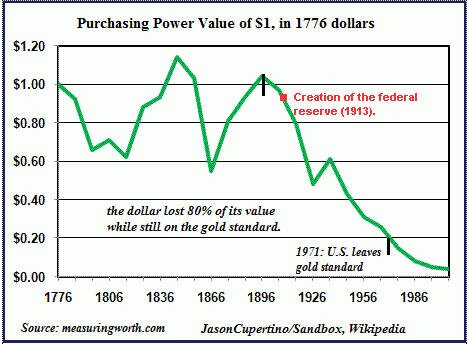
The Federal Reserve through its various monetary mechanisms has a major impact on the value of the U.S. Dollar and over time has destroyed the purchasing power of the fiat base currency used in the United States.
Interestingly enough, the following quote comes directly from the Federal Reserve’s website regarding one of its primary mandates, “In setting monetary policy, the Committee seeks to mitigate deviations of inflation from its longer-run goal and deviations of employment from the Committee’s assessment of its maximum level.”
The chart below illustrates the horrific job the Federal Reserve has done of protecting the purchasing power of the U.S. Dollar since its creation.
Dollar Creation By The Federal Reserve
In light of the longer-term malaise seen above, the Dollar Index futures have recently rallied sharply higher as Europe continues to flail in a slow and agonizing decline which will ultimately lead to a complete fiscal disaster.
Sovereign debt concerns continue to mount regardless of what the European technocrats spew publicly and the U.S. Dollar has been the primary beneficiary of these seemingly growing concerns.
This brings me to the purpose of this article. Most of the articles I write are focused on option based trades, but I decided it was time to put forth a more comprehensive scenario that could unfold over the next few years as a result of excessive monetary stimulus through various quantitative easing mechanisms developed by the Federal Reserve Bank.  “A mild change” to say the least . . .
As discussed above, the U.S. Dollar Index futures have moved higher throughout most of 2012. Any significant increase in the U.S. Dollar is a growing concern among central bankers as it correlates toward deflation. Deflation is the Fed’s biggest enemy, besides themselves of course.
Next week the Federal Reserve will release statements relating to the economic condition of the United States. Furthermore, the Fed also will discuss if it will initiate another dose of monetary crack for a capital market place that is addicted to cheap money and zero interest rates. At this point, the so-called marketplace is the antithesis of free by all standard measures.
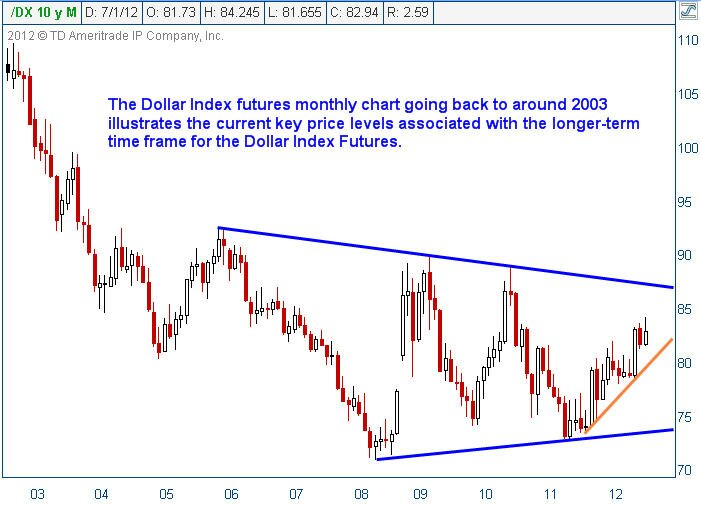
Consider the long-term monthly chart of the U.S. Dollar Index futures illustrated below:
Dollar Index Value Chart
The U.S. Dollar Index futures are in an uptrend that dates back to mid 2011. The orange line illustrates the uptrend and represents a key price level for the U.S. Dollar Index. For those unfamiliar with basic technical analysis, the rising orange trendline will act as buying support until the Dollar eventually breaks down through it signaling the bullish move higher has ended.
This brings us to a rather interesting potential observation. Today Mario Draghi, Chairman of the European Central Bank (ECB), made public comments regarding the readiness of the ECB to act if need be to safeguard the European Union. The Dollar Index Futures plummeted on the statement and remained under selling pressure most of the trading session on Thursday.
If a mere comment from the ECB can have such a damaging impact on the valuation of the Dollar, what would happen to the Dollar if the Fed initiated a new easing mechanism?
The answer is simple, the U.S. Dollar would immediately be under selling pressure. Selling pressure in the U.S. Dollar Index generally leads to a rally in risk assets such as equities and oil futures. Over the longer-term, a weak Dollar is also positive for precious metals and other hard assets.
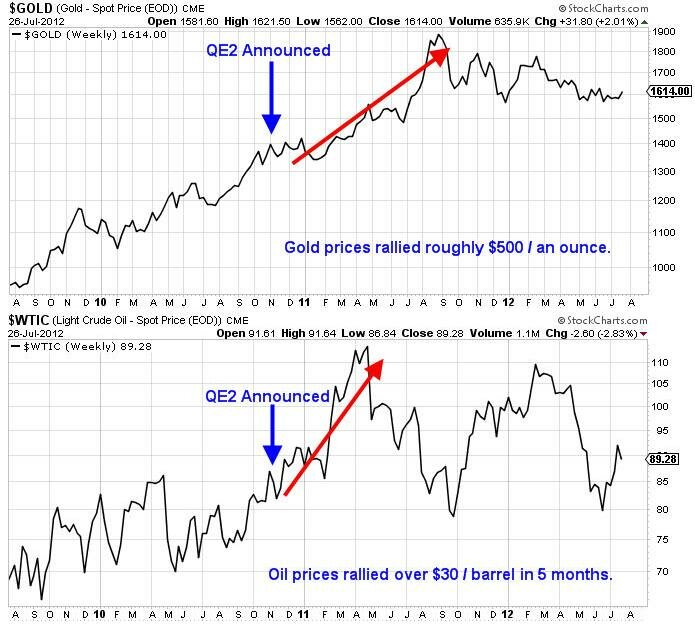
As an example to illustrate the power of Quantitative Easing as it relates to the price of both gold and oil, consider the following chart:
Spot Gold Price Chart
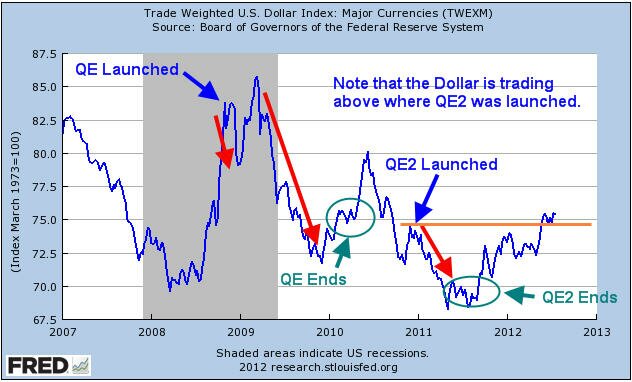
Obviously the price action is pretty clear that Quantitative Easing has a positively correlated impact on the price performance of hard assets, specifically gold and oil. Now consider a price chart of the Dollar Index shown below courtesy of the Federal Reserve Bank, the annotations are mine.
Quantitative Easing Effects
The chart above tells an interesting story about the impact that Quantitative Easing has on the Dollar. How can the Federal Reserve claim to be protecting the purchasing power of the U.S. Dollar when its actions have a direct negative correlation to the greenback’s price?
Furthermore, based on the chart above I am of the opinion that Quantitative Easing III is a foregone conclusion. The current price of the Dollar Index is clearly above the previous high where QE2 was launched. So far, the rally in the Dollar Index has not pushed equity prices considerably lower. However, should the Federal Reserve refrain from initiating additional easing measures it is likely based on the chart above that the U.S. Dollar Index will rally.
Upon the conclusion of both QE and QE2, the Dollar Index rallied sharply higher. With the Fed announcement coming closer by the hour, financial pundits will attempt to predict the future action of the Fed.
I have no interest in making predictions about what the Fed will do. It is a certainty that QE3 will take place at some point in the future whether it be sooner or later. The Federal Reserve simply has no choice, otherwise the Dollar would continue to rally and we would begin to go through a deflationary period which the Federal Reserve simply cannot tolerate.
The scenario that I would urge inquiring minds to consider would be as follows. If the Fed does nothing we can likely assume that the U.S. Dollar Index will continue to rally to the upside. Based on the price chart of the U.S. Dollar Index shown above, we can expect that sellers would certainly step in around the 86 – 88 price range based on previous resistance.
If the U.S. Dollar makes it anywhere near the 86 – 88 price range without the Federal Reserve initiating QE3 it would be expected that risk assets would be under considerable selling pressure somewhere along the way. Should the Fed act to break the Dollar’s rally either through more easing or “other” mechanisms, the result would be a potentially monster rally for risk assets, at least initially.
Equities, oil, and precious metals would rally on a falling Dollar as shown above. The question then becomes what if this is the last gasp rally before a monster selloff ensues in the Dollar Index?
If the Fed breaks the rally early or initiates a monster-sized easing program, the initial reaction will be quite positive, especially for equities. As the selloff in the Dollar Index worsens, equities would eventually begin to underperform as oil prices would surge putting pressure on the economy.
In addition to oil rallying on the weaker Dollar, we could also see sellers start to show up in droves dumping U.S. Treasury’s to any buyer left standing. International debt holders would especially have incentive to sell Treasury’s as the real purchasing power of the bonds’ interest payments would decline as the Dollar fell in value.
The way I see it, whether the Fed launches QE3 now or later, the outcome will not change. An extremely weak Dollar could wreak havoc across a variety of assets and the broader economy. Imagine where gasoline prices would be if oil prices hit $125 / barrel. The average price in the U.S. would be well above $5 / gallon based on current prices and possibly higher.
What happens to the economy if interest rates start to react violently to the price action in the Dollar? What if Treasury’s start to sell off viciously and interest rates start to rise wildly and volatility among bond holdings runs rampant? Are we to believe that the very entity that has created boom and bust cycles through easy monetary policies and has been oblivious to the bubbles that it has created is capable of solving the issues that would potentially arise from a currency crash in the U.S. Dollar?
The track record of the Federal Reserve is quite clear. They are generally late to the party and rarely are able to forecast events in the future with any clarity. Do you really think they will know what to do? The free market wants to destroy debt through deflationary pressure and price discovery and the Federal Reserve continues to get in the way.
The free market will win as it always does, but the American people will lose. This process may take months, years, or even decades to play out. Eventually the game will end. There is only one certainty should any portion of the scenario discussed above come to fruition, when the Dollar is inevitably broken the only safe place to hide during the potential currency crash will be in physical gold and silver. Paper money and paper assets will come under extreme selling pressure and in some cases will simply........disappear.
Here’s to hoping I am totally wrong!
Test drive our video analysis and trade idea service for only $1 at www.Trader Video Playbook.com


Get our Free Trading Videos, Lessons and eBook today!

Sunday, April 29, 2012

Why the U.S. Dollar is Critical for the S&P 500 Index this Week

Unfortunately I was sick the past few weeks and I am just now getting back into the swing of things. Similar to the demand pull that the warmer than usual spring has had on macroeconomic data, the warmer spring caused me to have an earlier than usual sinus infection as well as some horrific allergies. 
I suppose I am pushing it a bit far when I am comparing my health concerns to economic data, but alas I fly my nerd flag proudly.
Recently I have been advising members of my service to be cautious as the market appears to be at a major crossroads. The U.S. Dollar Index is on the verge of a major breakdown. If a breakdown occurs it will be clear that the Federal Reserve will have officially stopped any potential rise in the U.S. Dollar. 
Over the past few months the Dollar has been producing a series of higher highs and higher lows, however the current cycle may break the pattern.....as can be seen here.

Saturday, March 31, 2012

Option Trading: A Basic Explanation of Debit Spreads

Welcome back to the world of options. My reality exists in three dimensions and far more combinations of potential positions than does the one-dimensional world of the stock trader.
The view from my turret is ruled by the three primal forces of options — time to expiration, price of the underlying, and implied volatility. Consider for a moment the fact that each of these factors can independently impact a given option.
Multiply this by several available expiration dates and strike prices; add in the fact that individual option positions can include a variety of short and long positions at different strikes and expirations, and the potential combinations that make up an option position in a single underlying can approach a very large number.
For those traders first beginning to navigate this unfamiliar world, I think it is important to understand trade selection is manageable. There are certain families of trades that are unified by similar characteristics.
It is important to become familiar with the various trade constructions available to the knowledgeable options trader. Grouping the potential trades into related groups dramatically reduces the number of trade setups you must consider before entering a new trade.
If you are familiar with the various trade constructions, it makes discussion of a specific family member whom we may consider for employment in a trade far easier to understand.
Description of the family characteristics will take a little time, but it forms the framework on which we can hang the individual trades we will discuss in future postings.
I want readers to begin to become familiar with these patterns because it is these families of multi-legged option trades that we will return to on a regular basis to consistently perform for us.
Let me begin discussion of the various families by pointing out the redheaded stepchild of the trade constructions available. This family member, the single-legged position of being long either a put or call, is not completely without utility.
The reason for its seldom use is that for the knowledgeable options trader, this position rarely represents the best risk / reward structure given the variety of available trade constructions.
One basic and important family is that of the vertical spread. We will return several times to this family not only because of its utility in its basic form, but also because these spreads form the basic building blocks for more advanced spreads such as butterflies and iron condors.
The basic vertical spread is constructed by both buying and selling an option of the same type, either puts or calls, within the same expiration series. This is a directional spread with one breakeven point that reaches maximum profitability at expiration or when the spread has moved deep in-the-money.
It has a defined maximum profit and defined maximum loss when established. The spread is used to trade directionally in a capital efficient manner and largely neutralizes impacts of changes in implied volatility.
There are four individual vertical spread family members — the call debit spread, the call credit spread, the put debit spread, and the put credit spread. Each has its distinct and defining construction pattern. These are not the only names by which these spreads are known. Trying to keep independent option traders confined to a single set of terminologies is like trying to herd cats — it is not going to happen.
For this reason, the additional confusing and duplicative names for these spreads include bull call spread, bear call spread, bear put spread, and bull put spread. To make matters even more confusing, traders often refer to “buying a call spread” or “selling a put spread.” This multiplicity of names for the same trade structure is mightily confusing to those getting used to my world.
I am a visual learner and find that a picture is worth well more than the often cited thousand words. When I review in my mind the various option families available to use in trade construction, I think of the characteristic family portrait of each as displayed in the profit and loss, or P&L, curve.
Attached below is the first in our series of family portraits, but remember within this framework is abundant room for individual variation.

This particular example is a call debit spread, a bullish position in Apple (AAPL).
We will see trades displayed in this format with many variations as we meet the different families. The solid red line represents the profit or loss at expiration. The dotted line represents the P&L curve today and the dashed line the curve halfway to options expiration from today.
In future articles I will discuss other trade constructions that are regularly employed by experienced option traders. Until then, be sure to manage your risk accordingly.
In 2012 subscribers of my options trading newsletter have won 12 out of 13 trades. That’s a 92% win rate,  pocketing serious gains with the trades focusing only on low risk credit spread options strategies.
If you are looking for a simple one trade per week trading style then be sure to join Option Trading Signals.com today with our 14 Day Trial

Tuesday, January 17, 2012

The Dollar, Weak Earnings Indicate a Top is Near For The S&P 500

Can we still look to the financials to guide us on market movements?

Earnings season is now upon us and so far the only major earnings component that has been released is the J.P. Morgan earnings report that came in Friday before the market opened. After the report was digested by the marketplace, prices fell dramatically.

While the charlatans in Washington try to sell the American public into believing that the U.S economy is starting to firm up, the underlying truth is that the recovery has been relatively week. If it were not for the massive liquidity injections provided by the Federal Reserve through multiple quantitative easing adjustments, risk assets would likely be priced significantly lower.

Inquiring minds combed through the data provided in the J.P. Morgan earnings release and a few major outcomes were placed front and center. Earnings disappointed overall due to a massive decline in investment banking activity. Investment banking profits represent a large portion of all of the major banks’ earnings.

On Friday the guys at Zero Hedge provided the following chart in its article titled, “Charting Disappearing Investment Banking Revenues And Profits, JPM Edition.” The chart below illustrates the massive decline in investment banking revenue:


To make the chart a bit easier to follow, the blue bars represent investment banking revenue. It is rather obvious that investment banking revenue is in free fall having dropped nearly 50% since the first quarter of 2011. In addition, I would point out the sharp declines in total net income (purple) and the massive decline in equity market revenue (green).

It is without question that the other major banks that have a large investment banking presence are likely to experience similar revenue losses. A significant reduction in investment banking gross revenue puts tremendous pressure on total bank revenues in this quarter and looking ahead.

I am of the opinion that major money-center banks like Bank of America and Citigroup are likely to experience similar revenue reductions. We will know for sure in the coming weeks as most of the large banks are set to report earnings in the near term. Clearly this expected reduction in overall revenue will likely have a major impact on the financial sector of the economy.

The financial complex is absolutely critical when looking at broad index returns. It is common knowledge that broad indexes such as the S&P 500 and the Dow Jones Industrial Average struggle to rally when the financial complex lags. The same can be said for the semiconductor sector as well.
Recently financials (XLF) and the semiconductor (SMH) sectors have worked considerably higher on relatively light volume. Both XLF and SMH are trading into major resistance and both are starting to show signs that they are nearing a potential top  The daily charts of XLF and SMH are shown below:

XLF Daily Chart


SMH Daily Chart


Both the XLF and SMH daily charts illustrate that a major top may be forming in both sectors. It is widely noted that if the financials and semiconductors are not showing strength in a rising market, a correction or major reversal may not be far away.

I have been writing about the potential for a major top to be forming for several weeks now and I find that I am not in the majority in this viewpoint. Recent sentiment and momentum in U.S. equities demonstrate that we are very overbought at this time. Retail investors are extremely bullish and the Volatility Index (VIX) is trading near recent lows.

I am unsure whether this is a major top that leads to strong selling pressure or whether a correction is a more likely outcome. What I do know is that tops are a process, not a singular event and at this point more and more evidence is supporting the viewpoint that equities may be getting tired and some profit taking is likely.

In addition to the lackluster price action in the charts above, earnings releases have been revised lower in the 4th quarter of 2011. In fact almost 3.5 companies have announced earnings revisions to the downside for every company that has indicated a stable to rising earnings announcements. This type of scenario has not been present since the first quarter of 2008 which as we know was not exactly a great time frame to be looking to put cash into risk assets.

Furthermore, Goldman Sachs analysts came out with the following commentary, “While the 4th Quarter is typically the strongest quarter for earnings, estimates have fallen 9% since the summer and are now below both realized 2nd and 3rd Quarter results.” Goldman Sachs is also expecting significant price pressure coming from a weak U.S. economy and the fears of a European recession in 2012. Overall, the estimates are far from bullish and are in fact quite concerning when looking at the current valuation of U.S. equities.

The impact that a stronger U.S. Dollar will have on domestic companies which are used to having a competitive advantage when looking at earnings due to currency adjustments could produce negative surprises. Typically positive earnings adjustments are likely to be revised to the downside as the U.S. Dollar has rallied sharply higher in light of the weakening Euro currency. The weekly chart of the U.S. Dollar Index is shown below:


The U.S. Dollar Index is consolidating directly beneath resistance which is generally seen as a bullish development. I expect a breakout over new highs is only a matter of time. It is unlikely that in the long term the U.S. Dollar can rally while stocks trade flat or work their way higher. While this is always possible, the likelihood of that scenario is unlikely due to earnings pressures that would occur if the Dollar pushes higher in the intermediate term.

In addition to the variety of above mentioned factors which could have a major impact on equity valuations, the S&P 500 Index is trading into major resistance. Unless the S&P 500 Index can work above the 1,325 area it is unlikely that a new bull market has begun.

If the S&P 500 Index manages to work above the 1,325 level then my analysis may be proven completely incorrect. However, right now the S&P 500 Index has a lot of overhead resistance at the 1,292, 1,300, and 1,310 price levels. The daily chart of the S&P 500 Index is shown below’


Ultimately we are coming into the final week for the January options contracts which are set to expire at the close of business this coming Friday. I would not be shocked to see some volatility late this week and potentially even higher prices for equities.

However, my expectation is that once the January expiration hangover is behind us, increased volatility and lower prices are likely ahead for U.S. equities. The earnings announcements this week will likely have a large impact on the price action. Heads up, risk is exceptionally high!

To learn more about Options Trading Signals visit J.W. Jones Options Newsletter website.

Check out J.W.s latest articles

Sunday, December 11, 2011

Will The Dollar Ruin The Santa Claus Rally in the S&P 500?

Experienced traders recognize that volume typically dries up going into the holiday season. Light volume and the holiday seasonality generally push equity prices higher. The discussion of whether Santa Claus comes to Wall Street has arrived in earnest.

I do not envy Santa as he has the most arduous task of determining if Wall Street was naughty or nice. I suppose it depends on whether he reviews recent performance, or if past performance comes into play. Clearly coal will likely be found in a few stockings soon enough. If I were John Corzine, I would not expect to get a lump coal, but something far worse potentially.

In all seriousness, the bullishness has gotten pervasive in the media and economic data points such as unemployment and consumer credit have improved according to the government. One way to gauge investor sentiment is to look at the weekly advisor sentiment numbers courtesy of Bloomberg and Investor’s Intelligence.

According to this week’s advisor sentiment numbers, advisors who are bullish advanced to 47.4% from 44.2% last week. Bearish advisors dropped to 29.5% from 30.5% from the previous week. The 29.5% bearish data point matches a level that has not been seen in nearly 4 months. Bullishness has clearly become the leading expectation in the marketplace.

Only one asset has the opportunity to be “The Grinch” and ruin Christmas on Wall Street. If the U.S. Dollar rallies sharply, risk assets are certain to get hammered lower. In addition to the bullish tenor of market participants, most market pundits and gold bugs believe strongly that the U.S. Dollar is doomed fated for lower prices.

When I look at the long term momentum of a stock or commodity contract I will look at a monthly chart and plot the 12 month moving average against the price action. While it seems simple, equity and futures positions adhere to the 12 month moving average quite closely in many cases. The analysis is very simple as prices above the 12 month moving average equate to bullishness and prices below the moving average predict lower prices. The monthly chart of the Dollar Index futures is shown below:


As can be seen above, the Dollar Index futures are showing strength currently. The 12 month moving average is starting to flatten out which is also a bullish indicator. When looking at the daily time frame we can see that price action is trading inside a wedge pattern and is bouncing higher off of support:


An additional catalyst that could push the U.S. Dollar higher is the economic tragedy that is Europe. European political leaders need to come up with a series of strong solutions that will stabilize their economic crisis otherwise the Euro will weaken further. A weakening or potentially crashing Euro will push buyers back into the U.S. Dollar. This would in turn place downward pressure on equities and commodities.

S&P 500
On Thursday the S&P 500 flushed over 2% lower by the close as the European Central Bank disappointed investors with an expected 0.25% rate cut and no new bond purchase announcements. The bulls will tell you that the Thursday the week prior to monthly option expiration usually is volatile and price direction is generally in the opposite direction of the primary trend. We will find out next week whether that axiom holds true. The daily chart of the S&P 500 is shown below:


The strength of Thursday’s move is not going to easily be reversed. The European leaders need to shock the market with tangible decisions and launch a major offensive against their growing fiscal issues. If European leaders disappoint investors, the reaction to the news could be a violent selloff that leaves bulls flatfooted next week.

Those who are leaning long in size should consider that their trading capital is being leveraged on the hope that European leaders can come to a groundbreaking agreement. I will be in cash watching the price action in the S&P 500. However, once the dust settles and others have done the heavy lifting, I will likely get involved with a directional trade. Until then, I am just going to ponder if I were Santa, would Wall Street get a present or a lump of coal?

Get these weekly reports and trade ideas free at Options Trading Signals.com

Monday, October 31, 2011

The Unfortunate Truth About an Overbought Stock Market

Writing about financial markets is probably the most challenging endeavor I have ever immersed myself into. I am a trader first and a writer second, but I have really come to enjoy scribing missives about financial markets because it really forces me to concentrate on my analysis.

Writing for the general public has really enhanced my perception of the market and forced me to dig deeper and learn new forms of analysis. I find myself learning more and more every day and the beauty of trading is that even for the most experienced of traders there is always an opportunity to learn more. As members of my service know, I strive to be different than most of my peers as my focus is on education and being completely transparent and honest.

I want readers to know that I was wrong about my recent expectations regarding the European sovereign debt summit. I was expecting the Dollar to rally based on the recent price action and quite frankly I expected stocks to falter after running up nearly 15% into the announcement. My expectations could not have been more untimely and incorrect.

I share this with you because as I read and listen to market pundits discussing financial markets I find that too many writers and commentators flip flop their positions to always have the appearance of accuracy. In some cases, there have been television pundits that stated we were possibly going to revisit a depression in 2012 no more than 5 weeks ago. These so called experts have now changed their positions stating that we have started a new bull market in recent weeks. How can anyone take these people seriously?

Financial markets are dynamic and consistently fool the best minds and most experienced traders out there. Financial markets do not reward hubris. If a trader does not remain humble, Mr. Market will happily handle the humbling process for him. I was humbled this week. I was reminded yet again that  financial markets do not take prisoners and they show no mercy. I am sharing this with readers because I want you to know that I refuse to flip flop my position without first declaring that I was wrong.

When I am wrong, I will own up to it purely out of sense of responsibility. My word and my name actually mean something to me, and while I strive to present accurate analysis I am fallible and I will make mistakes. The key however to the mistakes that I make is my ability to learn from them and the past week was a great learning opportunity.

After regrouping and stepping back after the price action on Thursday, a few key elements really stood out to me regarding recent price action. First of all, in the short term we are extremely overbought. The chart below illustrates the number of stocks in domestic equity markets trading above their 20 period moving averages over the past 5 years:

Overbought Stock Market Chart
Overbought Stock Momentum

What is apparent from the chart above is that prices are almost as overbought right now as they have been anytime in the past 5 years. The number of domestic equities trading above their 50 period moving average over the past 5 years is also nearing the highest levels seen during the same period as the chart below illustrates:

Stock Market Momentum Trading
Trading Stock Market Momentum

Equities trading above the 100, 150, and 200 period moving averages are somewhat subdued by comparison meaning in the short run a possible correction appears likely. The longer term time frames are no longer oversold, but they have considerable upside to work with before we could declare that they are overbought.

Additionally, the details of the European Union’s supposed solution have not yet been released raising questions going forward. Every move that is made will create unintended consequences. As an example, since Greece had 50% of their debt written down why would Ireland or Portugal refuse to pay their debts in full?

The Irish and Portuguese governments are going to come under pressure from their constituents to renegotiate the terms of their debt based on the agreement that was made with Greece recently. Spain politicians will likely be under pressure as well. The decisions made in these so called bailouts reverberate across the geopolitical spectrum. Moral hazard still exists, it just evolves over time.

The risk premium of sovereign debt has to be adjusted since credit default swaps did not trigger payment as the write downs were considered “voluntary.” Thus credit default swaps are not the answer to hedge sovereign debt as it would appear that governments have the ability to write down debt without triggering a default based on the status of the write down. The long term unintended consequences could be severe and are unknown at this point in time.

In addition to the unknown factors impacting the European “solution”, next week the Federal Reserve will have their regular FOMC meeting and statement. There has been a lot of chatter regarding the potential for QE III to come out of this meeting. While I could be wrong, initiating QE III right after the Operation Twist announcement would lead many to believe that Operation Twist was a failure.

With interest rates at or near all time lows and the recent rally we have seen in the stock market, it does not make sense that QE III would be initiated during this meeting. It is possible that if QE III is not announced the U.S. Dollar could rally and put pressure on risk assets such as the S&P 500 in the short to intermediate term. If this sequence of events played out, a correction would be likely. The following is a daily chart of the S&P 500 with possible correction targets in place:

SPY Overbought Stock Market

Right now it is a toss up in the financial blogosphere as to the expectations of where price action will head. Are we near a top? Is this the beginning of a new bull market? I scanned through several charts Friday evening and Saturday morning and came to this realization. If the market is going to breakout and this is not a top but the beginning of a major bullish wave higher, then the Nasdaq 100 Index (NDX) has to breakout over the 2011 highs.

The Nasdaq 100 Index is comprised of stocks such as AAPL, GOOG, INTC, and YHOO. In order for a new leg higher to transpire, hyper beta names like AAPL and GOOG have to breakout higher and show continuation with strong supporting volume. If the NDX does not breakout over the 2011 highs, a top could potentially be forming. The daily chart of the Nasdaq 100 Index is shown below:

QQQ Overbought Market

In conclusion, the short term looks like a possible correction could play out. However, it is critical to note that the longer term time frames are more neutral at this time. Furthermore, if price action cannot penetrate the 2011 highs for the Nasdaq 100 Index, I do not believe that a new bull market will have begun. If the Nasdaq 100 Index cannot breakout above the 2011 highs, we could be putting in a potential top going into the holiday season.

In closing, I will leave you with the thoughtful muse of famed writer and minister Hugh Prather, “Almost any difficulty will move in the face of honesty. When I am honest I never feel stupid. And when I am honest I am automatically humble.”

Subscribers of OTS have pocketed more than 150% return in the past few months. If you’d like to stay ahead of the market using My Low Risk Option Strategies and Trades check out OTS at Options Trading Signals.Com and take advantage of our free occasional trade ideas or a 66% coupon to sign up for daily market analysis, videos and Option Trades each week.

J.W. Jones


Just click here to check out J.W.s latest articles.

Thursday, March 24, 2011

Modern Music, Options, the SPX, the XLF and your Mood!

What could modern music, options, the SPX, the XLF and your Mood have in common? Let's have options guru J.W. Jones tell us......

Before getting into the broader markets, I thought it was pertinent to share with readers that recently I have noticed a trend in alternative music, also known as modern rock. As a fan of music in general, I have noticed that more modern and mainstream music is starting to underscore the deterioration in social mood. Mainstream songs are having a resoundingly similar lyrical undertone which outlines the “us against them”, “rich versus poor”, and the political class versus everyone else.

While I am not a sociologist nor do I have any real training in the area, the underlying tone in a lot of artistic mediums highlights the current chasm between the haves and the have nots. While some might argue that it does not matter, if you as a reader, trader, or investor believe in behavioral finance you might agree that social mood matters a great deal. After all, the entire premise of technical analysis is an attempt to quantify market participant behavior at specific price levels.

Social mood is but one catalyst that can have a dramatic impact in price discovery, and thus must at the very least be monitored. Current music trends are literally screaming loud and clear that the average American can relate to the undertones and messages of song lyrics with the same resounding tone as the Rise Against lyrics listed above. Believe me, it may not matter right now, but it will matter and when it does it will likely be too late for financial markets.

Now that I have my little rant out of the way, why don’t we take a look at where the S&P 500 has been, where it is now, and where it might be going. Currently price action in the S&P 500 is sitting on the edge of a fence. We could be looking at an intermediate bottom or it could end up being a bull trap. As for me, my recent prediction for lower prices has indeed come to pass, but from hereon I have no real idea where price action is headed. Mr. Market is leaving a few clues behind which I will outline, but anything is possible. We have seen stocks climb a wall of worry for nearly two years now so there is precedent for a rally from this current point of indecision.

The daily chart of the S&P 500 listed below illustrates key technical levels on the daily chart, however readers will notice that we are currently caught between a ton of overhead resistance and a key support level. Until we see price move in either direction with volume confirmation, I will be sitting on the sidelines.


Another key chart to consider is the SPX weekly chart. A quick glance at the slow stochastic readings at the bottom of the chart reveal that the S&P 500 might have additional downside left before the market is able to form a solid bottom. If that is true, we could see the SPX test the 200 period moving average on the daily chart which would be around the 1186 price level. Additionally, the 50 & 200 period moving averages on the weekly chart correspond with the 1180 price level which is likely not coincidental. The level also corresponds with key resistance areas going back to the November 2010 lows. While a downward move that large seems a bit extreme to me at this point, anything is possible.


As can be seen from the chart above, price action is currently sitting above the 20 period moving average on the weekly SPX chart. Key support levels are around the 1225 and 1180 price levels. I would also point out that a Fibonacci retracement of the recent pivot high to the recent pivot low gives us a possible 1.618 retracement around the 1190 price level. Additionally, the slow stochastic on the chart above is eerily similar to levels that were seen on the weekly chart back in May of 2010. Will price action work lower? Will the weekly slow stochastic reading kiss the 20 level?

At this point, a few of you might think I’m outlining the case for lower prices in the equity market. I honestly have no idea where price is going from here, I’m just outlining some key aspects that I have found in my analysis to the downside. The upside is just as likely and we could see the SPX price bounce off of the 20 period moving average on the weekly chart and a challenge of the recent highs could play out. Should recent highs give way to breakout, the SPX would likely test the 1,400 price level at some point in the future.

If we look at the VIX for any clues, all that can be seen from that chart is a spike higher and a subsequent selloff as fear and uncertainty leave the marketplace. The VIX is currently arguing for higher prices in equities, however the financials represented by XLF are the fly in the proverbial ointment. The banks were unable to attract a bid on Monday’s strong advance and they experienced additional selling pressure on Tuesday.

In fact, the XLF’s daily chart shown below reveals a key test and subsequent failure.


A quick look at the XLF daily chart and it is rather obvious that price action in XLF has been weak in the past two sessions. Price moved higher off of the recent lows, tested the 20 period moving average and rolled over. Price is currently below key support levels, but we could witness a reversal on Wednesday. I am going to be watching the financials (XLF) quite closely in coming days as I believe the banks will provide traders with clues as to which direction Mr. Market is favoring. Right now it would appear that Mr. Market is favoring lower prices, but that would seem a bit too easy from these eyes.

We could consolidate at these price levels for a period of time. The volume on Monday and Tuesday was light and we have non confirming signals showing up in a variety of underlying indices. I am unwilling to accept any directional risk at this point. I will let others do the heavy lifting while I sit safely in cash and watch the price action play out.

The price action will eventually give us a confirming signal as to which direction prices will be heading, but right now I believe the prudent thing to do is remain in cash and wait for Mr. Market to signal which direction he favors. We are either sitting at the beginning of a major move higher or we are at a precipice and prices are about to plunge. Either way, risk remains high and the risk/reward is simply not there to warrant an entry. As I have said many times, sometimes the best trade is no trade at all!

Just click here to get J.W.'s "Profitable Options Strategies Report"


Share